

Language is a powerful yet deceptive thing. It can be used to convey someone's plight and it can also be used to hide unpalatable sordid deeds. Nowhere are words adulterated more for political ends than in Israel and Palestine today. It is no secret that Israel employs a legion of well-funded propagandists, and it also relies on self-appointed members of the press - the pro bono apologists, who serve the same purpose. Just like the lopsided imbalance of military power, the means to command and change language rests primarily with pro-Israeli propagandists. Their language obfuscates and exculpates Israel's actions against a basically defenseless population; it perpetuates the injustices and contributes to a continuation of Israel's occupation and theft of more land.
To make sense of the situation and to peer through the fog, a fraction of the post-Oslo commonly abused terms are translated in this glossary.
Palestinian Misery in Perspective
Date posted: July 28, 2004
By Paul de Rooij
This article first appeared on www.dissidentvoice.org on June 5, 2004
The media usually focuses on the latest casualty and quickly forgets those who died even a few days before. The American media in particular has a Dracula-like predilection for warm bodies, and no interest in cases where blood has already dried. Unfortunately this ahistoric focus on the last victim hides the scale of mass crimes and the responsibility of various perpetrators. Whether in Iraq, Palestine, Colombia, or Haiti, it is necessary to locate human rights abuses in a wider context to appreciate the scale of what is occurring on the ground.
In the case of Palestinian casualties, it is all too evident that CNN, BBC, and most other major media are mostly interested in today's casualties: they seem to studiously ignore precedents, and above all, they will not refer to the pattern of killings as systematic in nature. Of course, admitting that such killings are systematic would imply that Israel is committing “crimes against humanity”, a precursor to genocide. When the media seeks to whitewash “friendly” mass crimes, there is a tendency to fixate on specific instances to the exclusion of broad patterns. Even when a pattern of killings and other abuses is chronic and systematic, the BBC/CNN will tend to focus on specific cases without reference to broader trends. When referring to Palestinian conditions, what we find is that reports of casualties, house demolitions, and dispossession in these media outlets pertain to specific cases and not to general patterns. [1] Incidentally, the opposite is true when there is an incident of Palestinian violence; here lists and charts are available to highlight their context.
The chosen context can be used to obfuscate the reality on the ground. The tools at the media's disposal can be likened to an instrument of variable magnification ranging from a wide-angle lens to a telescope. Informative journalism requires using the most appropriate level of magnification for the story under investigation. On the other hand, propaganda requires contextual blurring and the use of inappropriate tools. Thus, it is best to use a telescope to view the stars, and clearly, a wide-angle lens is the wrong tool. In the case of Palestinian casualties, it is evident that the mainstream media are intent on presenting news using a telescope (preferably out of focus), when a wide-angle lens should be used.
The tables and graphs below put the Palestinian casualty toll into perspective over the course of the second intifada. These graphs speak for themselves, revealing a pattern that is all too evident. These graphs are meant to fill a gap in the available data pertaining to the casualty toll during the second intifada.
Average death tolls and an interpretation
During the course of the second intifada, the average number of Palestinians killed stands at 2.26 per day. The total killed between September 29, 2000 and May 31, 2004 is 3,023. To interpret these numbers one must scale these figures to make them comparable to understand what they would mean in the context of our own countries. This is the purpose of the table below.
|
Average and total Palestinian fatalities during intifada II,
Sep. 29, 2000 — May 31, 2004. Actual and population scaled numbers |
||||
|---|---|---|---|---|
| Av. Fatalities/day | Total fatalities | scale factor | Population size (m) | |
| Palestine | 2.26 | 3,023 | 1 | 3.7 |
| US | 177 | 236,938 | 78 | 290.0 |
| UK | 37 | 49,022 | 16 | 60.0 |
| Spain | 25 | 32,844 | 11 | 40.2 |
| Explantion: | ||||
| Column (1) The average fatalities per day for the Palestinians is an actual number. The numbers below this have been scaled using the scale factor in column #3. | ||||
| Column (2) is analogous to column #1, but refers to the total fatalities. | ||||
| Column (3) is the scaling factor derived from the population numbers in column #4 | ||||
An average daily fatality rate of 2.26 would proportionally equate to 177 deaths per day in the US. Similarly, the total Palestinian fatalities of 3,023 would equate to 236,938 in the US. One wonders how Americans would react if they experienced such a fatality rate, i.e., they would suffer a 9-11 death toll every two weeks. One suspects that there would be a level of mass hysteria, and rightly so. Actually, Americans are prone to suffer from mass hysteria with far less provocation. The Washington DC snipers killed ten and wounded three during a three-week “killing spree”; this is relatively minuscule when compared with the Palestinian experience. However, the media stoked a level of mass hysteria about these killings; Americans were even afraid to fill up their SUVs at the gas station — heavens! Americans are entitled to their hysteria about sniper killings, but then they should be aware that they finance the Israel military machine and support Ariel Sharon to the hilt, and therefore they have direct responsibility in the killing of 2.26 Palestinians per day (on average), something that would translate to 177 deaths per day in their society. While in the US such numbers would be abhorrent, when it comes to Palestine, Americans even provide the bullets and untold billions of dollars in funding. While the US justifies “preventive” wars, the abrogation of democracy, etc., after suffering 3,000 fatalities during 9-11, it lambastes and demonizes a brutalized Palestinian population which is suffering a death toll that is several orders of magnitude higher in terms of a scaled fatality rate.
Before anyone objects to the use of these scaled numbers, consider that Israel has frequently used such statistics for its own ends – referring exclusively to Israeli casualties. [2]
Average fatalities per month
Graph 1 plots the average death toll per month during the second intifada. It has fluctuated depending on Sharon's willingness to play along with “peace processes” and temporarily alternating with his proclivities to demolish Palestinian hopes for an independent state. Thus during the attack on the West Bank in April 2002, about eight Palestinians were killed every day. [3] While it was convenient for Sharon to play along with the Aqaba peace negotiation appearances, only 0.3 Palestinians were killed per day – the lowest level during the intifada.
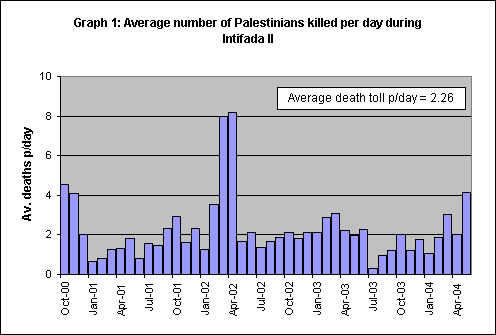
What is also evident is the escalation of the fatality rate after July
2003. After the Aqaba summit, it was not possible to obtain any
meaningful negotiations due to the inexorable building of the land-grab
wall. Inevitably, the on-going ethnic cleansing and dispossession gave
rise to an increasing death toll. From the graph it seems that the
Israeli military increase the level of dispossession or killings in a
gradual fashion. If they can get away with killing four Palestinians per
day now, then we can expect a gradual increase in the following months.
While killings, destruction, and dispossession remain under a magic
threshold level, the media will not consider this to be “news”. Even
human rights organizations aren't much bothered if the killings remain
below this threshold. Of course, if some egregious killings take place,
then Amnesty International, the Mother Theresa of the human rights
organizations, will suggest that the killings “were not proportionate”,
and occasionally it will utter a condemnation. Killings under the magic
threshold are presumably “proportionate” and thus can be ignored.
And the wounded
Even when the mainstream media will say something about fatalities, the wounded are mostly ignored. However, consider that Israel uses heavy-duty battlefield weaponry against a mostly defenseless population in densely populated civilian neighborhoods, where the effect of these weapons on their victims is devastating. Even the so-called non-lethal bullets create harrowing wounds; even tear gas can be fatal or cause permanent lung damage. There are tens of thousands of wounded with permanent disabilities: blindness, paraplegia, as well as loss of limbs. These numbers are staggering, and a tremendous burden for a society already on the edge.
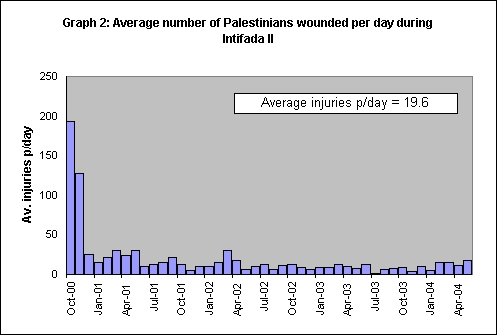
The average number of injured Palestinian victims stands at 19.6 per
day (the US scaled equivalent would be 1,540). This number includes
victims shot with military high velocity bullets, the so-called plastic
or rubber bullets, tear gas and other unidentified gases with
neurological effects, helicopter gunfire, and other large military
ordnance. One must also remember that at the beginning of the
intifada 193 Palestinians were injured on average every day. The
Israeli army used millions of bullets during the first month of the
intifada – and their effects were all too evident. [4]
The nature of the wounds
While at the beginning of the intifada a significant percentage of the casualties were shot with so-called non-lethal bullets, the ratio of casualties due to this type of weaponry has fallen significantly. It is increasingly rare to find Israeli soldiers using “plastic bullets” (in reality plastic-coated-bullets); the predilection today is to use “high-velocity bullets”. Graph 3 shows that the percentage of injuries due to “live ammunition” has increased steadily. In other words, this implies that the use of “non-lethal” bullets/weapons has fallen over time. However, the graph hides some increasing trends. Someone wounded by a missile fired by an Apache helicopter enters the “other” category, and hence it doesn't register as “live ammunition”. The reason why the “live ammo” ratio has fallen during the past few months is directly attributable to wounds caused by helicopter or tank fire. The graph (not shown) with the “other” category as a ratio of total injuries shows a steady increase.

Injuries and deaths
Injuries and deaths
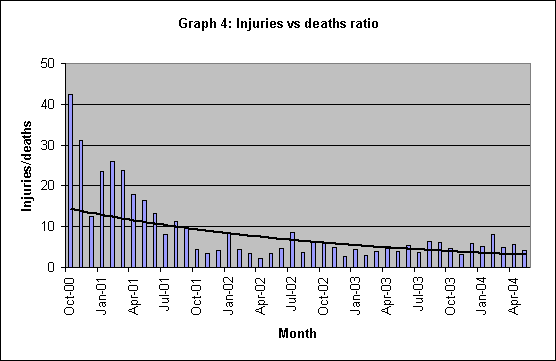
Graph 4 shows the number of injuries in relation to deaths over the same period. Thus at the beginning of the intifada there were a large number of injuries for each fatality, and this ratio has fallen steadily. The reason behind the dropping trend is the changing nature of the confrontation. Whereas at the beginning there were many popular demonstrations with a large number of ensuing wounded victims, this has steadily given way to sniper fire, helicopter or tank fire. The latter is more lethal, and the resulting ratio of injuries to fatalities tends to be lower. A reduction in this ratio sometimes implies an increase in the lethality of the Israeli tactics: they are increasingly shooting to kill.
Interference with medical treatment
A clear crime committed against Palestinians is the destruction of ambulances, abuse of ambulance staff, and the impediment of access to medical treatment. The summary statistics during the intifada are the following:
|
Obstruction and destruction of ambulances in Palestine. Data refers to the second intifada up to May 28, 2004 |
|
|---|---|
| Attacks on ambulances to date | 302 |
| Total ambulances damaged | 126 |
| Total ambulance personnel injured | 198 |
| Total ambulance personnel killed | 12 |
| Denial of access to ambulances (recorded instances) | 1,376 |
| Number of ambulances damaged beyond repair | 28 |
| Source: Palestine Red Crescent Society | |
The Palestine Red Crescent Society, keeps meticulous statistics and it is worth studying this graph. If one found that the most of the damage occurred during the April 2002 attack, then maybe this would be understandable. However, the recurrent pattern is a steady interference and destruction of Palestinian ambulances; the graph makes this very clear. Even though a so-called peace process was kicked off in July 2003, the level of ambulance destruction continued unabated. One could easily imagine the howls of indignation and disgust if Palestinians were to shoot up an Israeli ambulance or just impede its access. However, destruction of these increasingly important vehicles, or even their commandeering by the Israeli military is a media nonevent.
Is it Genocide?
It is evident that Israel under Ariel Sharon is pursuing relentless campaign that aims to drive the Palestinians off the land and dispossess an ever-greater number of people. The construction of the wall is proof that this policy is being implemented. Driving armored Caterpillar bulldozers through refugee camps obviously entails a casualty toll. Similarly, the usually violent suppression of the demonstrations against this policy conjures its own grim statistics. From the graphs we detect a pattern: the repression is systematic and gradually increases the severity of its methods – this is especially apparent after July 2003. In Ariel Sharon's calculus, and with American blessing, the dispossession and repression of the Palestinians can continue as long as it is performed gradually with a slowly increasing rate. So, mass abuses are occurring in the occupied territories today; these are chronic, and indeed systematic. When the scale, intent and period are taken into account, then one can only conclude that Israel's policy is genocidal. [5]
Please note that this is not a conclusion that could only have been reached recently. In December 2, 2000, Francis Boyle, a professor of International Law at Univ. Illinois, Urbana-Champaign, stated:
I am sure we can all agree that Israel has indeed perpetrated the international crime of genocide against the Palestinian People. [6]
So, who will take responsibility for blowing the whistle and classifying Israeli actions as genocide? Unfortunately, this has to be determined by the UN Commission on Human Rights or the General Assembly, and the legal basis for the classification of genocide is the UN convention against Genocide. [7] There are numerous obstacles before the UN will take any action because of this arrangement. Via a private communication with senior UN personnel, we discover that there has been no movement whatsoever at the UN to determine if Israel's policies are genocidal, confirming that the UN's role in preventing genocide is hopeless. It is very likely that the UN will not move at all regarding Palestine.
The explanation for the UN's inaction has much to do with the US's role at the UN; this has been less than constructive, and it will pressure member countries to avoid issuing a “genocide” warning. [8] One only has to remember the US efforts prior to February 2004 to block the International Court of Justice's hearings on the land-grab wall; to defend its client it attempted to obstruct this international legal body. Furthermore, the UN convention against genocide is very narrowly defined and it is almost the case that genocide can only be determined after the fact. The convention almost guarantees that there will be no action to prevent genocide or stem an on-going genocide. Finally, the insufferable Kofi Annan is known for his callousness and inaction in the face of mass slaughter. As head of UN peacekeeping forces during the Rwandan genocide, he was instrumental in delaying and obstructing UN action. As Michael Hourigan, a UN war crimes investigator in Rwanda, stated: “consistently, repeatedly people like Kofi Annan failed to act.” And the UN's Carlson Commission, an internal inquiry about the Rwandan genocide, actually blamed Kofi Annan and the unit he led. [9] Annan's record of inaction bodes ill for the UN to engage in any action to lend international protection to the Palestinians, a population that has been brutalized for many decades.
Further reading
-
Francis Boyle, Palestine Should Sue Israel for Genocide before the International Court of Justice, MediaMonitors, December 2, 2000.
-
Ward Churchill, A Little Matter of Genocide, City Lights Books, 1997.
-
Linda Polman, We did nothing: Why the truth doesn't always come out when the UN goes in, Penguin Viking 2003.
-
Paul de Rooij, Ambient Death in Palestine, DissidentVoice, June 21, 2003.
Paul de Rooij can be contacted at proox@hotmail.com (NB: all attachments will be deleted automatically). ©2004 Paul de Rooij
Data Sources
The data used in this article originates from the
Palestinian Red Crescent Society – with one small modification
discussed below. This is a high quality database and the origin of its
data is from the PRCS hospitals and medical staff. The numbers are
conflict-related deaths and injuries, which includes all Palestinian
killed or injured irrespective of cause. PRCS numbers are closely
related to the Health Ministry numbers, but they are not the same. The
Palestine Authority is now publishing its numbers on its website, and
data quality has improved over time. The PA's statistics can be found
here. Finally, the
Palestine Monitor also publishes good quality data and can be
found
here. The total casualty numbers of these three sources are not
equal, yet there is only a minor discrepancy. Part of the reason for the
discrepancy has to do with the reported numbers during the April 2002
attack. In many instances, there was no access to hospitals, victims
were buried without adequate record keeping, or victims were removed by
the Israeli army. PRCS's approach has been to zero out most of the
entries of this period, and thus understates the total casualty figures.
The Palestine Monitor has imputed some numbers to this period based on
interviews with residents and victim exhumations. The approach taken in
this article was to use Palestine Monitor data for the months that were
zeroed out by PRCS. This makes a difference of 19 fatalities.
Endnotes
[1] The opposite also happens. That is, if confronted by a particularly
egregious Israeli crime, this can be whitewashed by placing it in a
wider context. Alternatively, Israeli actions can be juxtaposing with
Palestinian violence – thus the Israelis are only responding.
[2] See
Israel's Campaign of Misinformation, The Palestine Monitor,
January 14, 2004.
[3] Please note that the statistical record during the April 2002
military assault on the West Bank is incomplete. For example, not
withstanding the UN or Amnesty International reports, it is not known
how many people were killed in Jenin or the West Bank during this month.
NB: Because the investigation was vetoed by the US, there was no
in-depth investigation of the killings in Jenin.
[4] Source: Raji Sourani, Lawyer and Director of the Palestinian Center
for Human Rights in Gaza. Data provided during his “The worst yet to
come from Occupied Palestine” lecture in London, October 11, 2002.
[5] Mass killings don't need to occur before mass abuses can be classed
as genocide. See Ward Churchill, A Little Matter of Genocide,
City Lights Books, 1997, pp. 399 – 444.
[6] Francis Boyle,
Palestine Should Sue Israel for Genocide before the International Court
of Justice, MediaMonitors, December 2, 2000.
[7] The official name of the convention is: The International Convention
on the Prevention and Punishment of the Crime of Genocide, UN, 1948.
[8] In the late 1940s, the US sought to wreck and postpone the UN
convention on genocide. It managed to have the principal architect of
the convention (Raphael Lemkin) removed; it then reduced the scope of
the convention thereby eliminating its effectiveness in preventing
future genocides. Even after wrecking the convention, the US didn't
ratify it but delayed until 1988 when it gave a conditional
ratification, and ratified it only after adding many provisos that
rendered the convention toothless. For an excellent discussion of the
American machinations surrounding the convention see Ward Churchill,
A Little Matter of Genocide, City Lights Books, 1997, pp. 363 – 393.
[9] Judi Mcleod, “One minute for 100 days of Rwandan hell”,
CanadaFreePress.com, April 5, 2004. Also important: Per Ahlmark, “UN
chief's career clouded”, The Australian, May 3, 2004. Finally, this
article also contains important info: Max Teichman, “UN: Kofi Annan and
the Rwanda genocide,” NewsWeekly, April 24, 2004.