

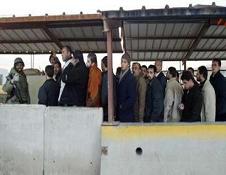
On a Thursday morning like all others two weeks ago, Palestinians from Jerusalem woke up early, got in their cars and drove to their workplaces. The story is normal so far. As they approach the Qalandia checkpoint at the end of a long and towering concrete wall north of the city, the story takes a turn for the worst.
Hundreds of cars were vying to get through the checkpoint and despite the obvious fact that many were being turned back; it did not deter newcomers to the chaotic queue, who were resolved to squeeze through to get to their jobs in Ramallah.
Once drivers reached the soldiers no amount of haggling would persuade them to let people through. “Prove you work in Ramallah and I will let you pass,” one soldier said, all the while holding onto the driver's blue ID card until she made a U-turn back to Jerusalem.
The only parking lot on the Jerusalem side of the checkpoint had already overflowed to the street as hundreds of drivers parked their cars and walked through instead. The rumor that flew that day was that a new military unit that did not know any better was implementing some obscure law that prevents anyone with a Jerusalem ID card entry into Ramallah.
What transpired in the following two weeks is extremely worrisome and should raise warning bells everywhere. The rumor turned out to be true: starting July 2005 this ban on movement will be implemented completely, which will bring losses to many Palestinians from Jerusalem.
Everywhere in the world people live in one city and commute to another for their jobs; this is perfectly normal – except in Palestine. There are no statistics of how many will lose their jobs, but if you stand at Qalandia checkpoint at peak hours during the day, it is clear that Ramallah is a hub of jobs, trade and other activities. Will those who commute daily to Ramallah for their livelihood be compensated by the Israeli welfare system for the loss of income? What will Israel do with the scores of hundreds of people who will suddenly be unemployed? Will it offer new job opportunities? Or is this merely a way of forcing internal migration to Ramallah in order to strip the Jerusalem residents of their IDs and any right to reside or enter Jerusalem and to "cleanse" Jerusalem of its Arab inhabitants?
Israeli policies being enforced in Jerusalem should not be taken at face value, nor should they be viewed as a legitimate manifestation of the application of law. Palestinian residents of Jerusalem remain Palestinian whether Israel cuts them off from their brethren in the West Bank or not. Creating a physical rift between the two cities would make it increasingly difficult for Jerusalemites to participate in Palestinian political life, as well as other aspects of Palestinian civil society and institution building and will only serve to negate Jerusalemites' Palestinian identity.
The issue of Jerusalem as a whole, including the Wall, the ban on the movement of Jerusalemites to Ramallah and the recent application of the Absentee Law, needs to be seriously addressed through diplomatic and legal means, not just discussed in passing with the occasional shallow news bulletin here and there. East Jerusalem is still an occupied city and international law must be applied in order to safeguard the rights of the occupied population living there. A concerted media and diplomatic campaign on the international level must be set in motion to stop efforts to turn Jerusalem into an exclusive city, where the Palestinian residents become an ever-shrinking minority with no rights and few employment prospects.