


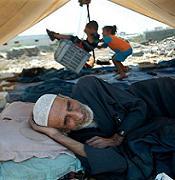
A recent report released by the Special Envoy for the UN Human Rights Commission, John Dugard, stated that the ‘Gaza disengagement plan’ will not mean an end to the Israeli military occupation of Gaza. The main proof of this is Israel’s insistence on maintaining control over all the borders, including territorial waters off the Gaza coast and supremacy in the airspace above Palestinian territory. So, if Gaza will remain occupied, it is worthwhile exploring what disengagement really means!
With almost complete certainty one can say that Israel will go through with its proposed ‘unilateral disengagement plan.’ The current Israeli cabinet has invested far too much time and energy to scrap this ingenious idea now. The Israeli government has succeeded par excellence in its effort to promote the 'disengagement plan' to the international community, as well as to the international media, to the extent where impartial international officials such as UN Secretary-General Kofi Annan actually look forward to the ‘unilateral disengagement’ in an effort to reactivate the peace process. Since its introduction in late 2003, the ‘unilateral disengagement plan’ has gone through an array of legal and political referenda within the Israeli political system, so as to make it palatable to the Israeli public, the most recent example of which was the decision by the Israeli Supreme Court to deem the ‘disengagement plan’ ‘legal.’
In more recent developments, so as to give the ‘Gaza disengagement plan’ a more human and legal touch, the Israeli cabinet agreed to create a 'coordinating committee' with its Palestinian counterparts, however, only eight weeks before the go-ahead. Since the 'unilateral disengagement plan' is a unilateral measure, the coordinating committee will deal exclusively with logistical and civilian matters, which include:
- The post-pullout operation of the crossing points into and out of Gaza
- The fate of the Salahuddin (Philadelphi) corridor between the town of Rafah and the Egyptian border
- A “safe passage” for Palestinians between Gaza and the West Bank
- The operation of Gaza International Airport.
However, what does this ‘disengagement plan’ really mean: for the Palestinian people, the peace process, and for reality?
Well, for the Palestinian people as whole, the disengagement from Gaza comes at a very high human cost, with approximately 2,015 residents of Gaza being killed in only the last 5 years. After 38 consecutive years of illegal military occupation, the State of Israel under the leadership of probably one of the biggest war criminals history has ever come to witness, Gaza today resembles the site of a humanitarian catastrophe, with virtually no sufficient infrastructure, sanitation, social services and most importantly no positive economic prospects left for the inhabitants of Gaza. Once Israel effectively disengages from Gaza, with almost complete certainty one can say Gaza will become yet another open air prison, similar to the one created in the Palestinian city of Qalqilya in the northern West Bank. Frankly, the disengagement plan, no matter how positive it has been portrayed, is a yet another episode in a long list of crimes and tragedies Palestinians have had to face in their modern history.
In terms of the peace process, the ‘Gaza disengagement’ has only one meaning. It is a unilateral measure, not bilateral, and certainly not multilateral. With concerns to peacemaking, the ‘Gaza disengagement plan’ is a most tragic and possibly irreversible setback. By definition, a peace process, involving two conflicting parties, should include; dialogue, negotiations and ultimately concessions. Effectively, as soon as Israel finishes the construction of its illegal Wall, while the world’s attention is solely focused on the ‘unilateral disengagement,’ Palestinians will be left with 12% of historic Palestine, which, knowing Israel, will be subject to further negotiations. The peace process as we know it today, has been so derailed by Israel and the U.S., that it has become a most vague process, lacking clearly defined principles, where nobody except Israel and the U.S. know what this new peace process is based on. The ‘Gaza disengagement plan,’ goes against the land-for-peace formula, the Road Map to peace, UN Security Council resolutions 242, 338, 1397 and international humanitarian law, as well as all other legal foundations on which a viable and just peace must be based.
In reality, the ‘unilateral disengagement plan’ is a measure that is complementary to the Israeli governments’ policy, of being in a mad rush to create new and irreversible facts on the ground, in east Jerusalem and the West Bank at large. In a recent briefing by the Palestinian Legislative Council member and Secretary-General of MIFTAH (The Palestinian Initiative for the Promotion of Global Dialogue and Democracy), Dr. Hanan Ashrawi commented on the recent decision by the Jerusalem Municipality to demolish 88 homes in the Silwan neighborhood by describing the move as an attempt at “Maximizing geography while minimizing demography.” With all the negative aspects that have been mentioned concerning the ingenious ‘unilateral disengagement plan,’ it is an imperative to uncover what it really means. In actual fact, the Gaza disengagement plan is a smokescreen or PR plot, to divert international attention from Israel’s continued land acquisition policy, pursued with concerns to the status of Jerusalem, and the West Bank. While the world at large focuses on the ‘Gaza disengagement,’ Israel is continuing its theft of Palestinian land, home demolitions at frightening rate, as well the continued construction of the ‘Segregation Wall,’ ultimately aiming to ethnically cleanse and simultaneously Judaize east Jerusalem and the West Bank.
Let us not fool ourselves, or be fooled, by the productivity and effectiveness of unilateralism. Unilateral acts and/or measures have a long history in backfiring. Bilateralism might prove to be a miracle cure for those who really yearn for peace in the Middle East. To speak of multilateralism under the current circumstances, would involve Israel taking a leap of faith, which is, frankly, very doubtful.
Believing in Jerusalem
Date posted: May 27, 2013
By Joharah Baker for MIFTAH
Last week, Israel barred a UNESCO fact-finding mission from entering the country, charging that the Palestinians had ‘politicized’ the mission before it had even arrived. The mission was tasked with looking into conditions of historical sites in the Old City of Jerusalem, something Israel apparently found to be very threatening.
Looking at the state of Jerusalem’s eastern sector today, it is understandable why Israel would not want UNESCO or anyone else walking around the Old City, especially the Palestinian-populated parts of it. Because anyone who does, will see the devastation that Israel and its settlers have wreaked on one of the oldest and most beautiful cities in the world.
Excavation works are being conducted in and around the Aqsa Mosque to make way for more Jewish construction at the place where Waqf authorities say Ottoman and Abbasid artifacts have long been tucked away. A Muslim graveyard is being dug up just outside the Old City’s Jaffa Gate, to build – ironically – a museum of tolerance. Today, two stores were forcefully taken over by Jewish settlers in Al Hakari, one of the neighborhoods in the Muslim quarter and every day, it seems that more and more homes are either being demolished by Israeli municipality authorities or being taken over by Jewish settlers.
The “Judiazation” of Jerusalem is a term many Palestinians and Arabs use for what Israel is doing in the city. In a nutshell, it is the long-term plan Israel is gradually carrying out to change the Arab Palestinian character of Jerusalem. This means demolishing old and historical structures, displacing Palestinians, handing over their homes to settlers and trying to erase the Palestinian or Arab history of the city.
The sad truth is that, on the surface, Israel has succeeded in this to a large extent. Pockets of Jewish settlers now live in the heart of Muslim quarters and aim to take over more and more. Sheikh Jarrah, one of the more affluent Palestinian neighborhoods of Jerusalem, is now pierced with Jewish flags waving from homes that have been wrestled from their Palestinian owners, and Israel’s light rail train cuts right down through Palestinian neighborhoods outside of the city center. The train, of course, is not meant to service the Palestinian population but rather to connect Jewish neighborhoods and settlements in the city, but the area confiscated from Shufat and Beit Hanina for its construction simply fell into the plan.
What the UNESCO mission would not have seen even if they made it into the Old City is the overall humiliation that the Palestinian population of Jerusalem must endure on a daily basis because of Israel’s military occupation. Trips to the Israeli ministry of interior must be made just to prove that one lives in the city for fear that their residency rights may be revoked; young Palestinian men are stopped randomly by Israeli soldiers to check their ID cards or just to harass them, and settlers are always given the luxury of maximum security whenever they walk the streets. If settlers want to march through the city, the Palestinians are told to close their shops, are barred for hours from reaching their homes if they run along the path of the march and are always the ones blamed if any kind of confrontation between the two sides breaks out.
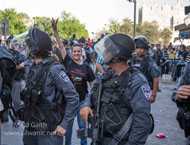
Jerusalem is being squeezed by these measures more and more each day. But there is always that glimmer of hope, that strength that shines through proving that all is not lost. On Shavuot, Israeli settlers and extremists poured into the Old City, singing loudly, banging on the shop doors and waving huge Israeli flags. The sight was disconcerting to say the least. However, the afternoon of that same day, at Damascus Gate, passersby were met with a completely different scene. Palestinian flags waved in determined Palestinian hands under the threatening eye of heavily armed Israeli police and soldiers. The youths were fearless, demanding freedom, with strong, unrelenting voices.
The sight of the Palestinian flag waving at the entrance to Damascus Gate was a breath of fresh air. All is not lost and never will be because hope is eternal and determination and strength come from a never-ending spring.
That day at Damascus Gate is what all Palestinians must keep in their minds’ eye in spite of the daily oppression of the occupation. No matter how many missions Israel bars from entering or how many houses it takes over, there will always be those brave souls who, despite the risks, will always raise Palestine’s flag.
Joharah Baker is a Writer for the Media and Information Department at the Palestinian Initiative for the Promotion of Global Dialogue and Democracy (MIFTAH). She can be contacted at mid@miftah.org.
Let Mohammed rest in peace
Date posted: May 20, 2013
By Joharah Baker for MIFTAH
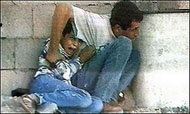
There is no point falling into the pit of countering the claims being made about the death of Mohammed Al Durra, the 12-year old boy from Gaza whose videotaped killing was seen around the world. The boy, crouching in fear behind is equally afraid father as bullets whizzed around them, was killed admittedly by the Israeli army. Later, the army recanted after investigating the tape, saying Durra was killed by Palestinian fire instead. Well now, Israel is changing its story altogether, saying he was not killed at all. In fact, he was probably not even wounded and the French channel that broadcast the footage and brought some pretty bad rap to Israel, had most likely filmed a charade.
The reason why I will not waste my time countering this claim is that even with the great lengths the Israeli government went to to prove that the boy was never killed, it could not provide any irrefutable proof that Mohammed Al Durra – who would be 25 now – is still alive. No pictures, no testimonies, no hospital or morgue officials giving statements to refute his death, have been provided. Only sketchy information about ‘poor quality footage’ and the fact that it seems as though the boy moved his arm after he had slumped over his father following the explosion.
My point is this: indeed, Mohammed Durra’s death was at least one of the catalysts that fueled the second Intifada, and thus, was an important event in the history of the Palestinians. However, more importantly – most importantly to me –is the fact that this is about a boy who died in sheer terror, with his distraught father futilely trying to shelter him from the barrage of bullets coming their way.
Mohammed Al Durra was a boy, with a life, a family and friends. He died a horrible death and now he is being made to die a second one. I did not know Mohammed or his family, but I can only imagine how awful it must be for them to read these claims now and feel the pain of losing their child all over again. If nothing else, this is disrespect for human life of the worst kind.
Some may postulate that the rehashing of the Durra case is a personal jab at the French cameraman who shot the footage, Charles Enderlin. Perhaps. But as a Palestinian who has seen the pain endured by numerous families who receive the horrible news that their sons or daughters have been killed by the Israeli army, my concern is for his family and for his memory. He should be left to rest in peace. If Israel has axes to grind with French journalists or with the international community for holding it accountable for its actions, then so be it. Israel is not lacking in the public relations department.
That being said, there is just one decent thing left to do. Leave Mohammed Al Durra and his memory alone.
Joharah Baker is a Writer for the Media and Information Department at the Palestinian Initiative for the Promotion of Global Dialogue and Democracy (MIFTAH). She can be contacted at mid@miftah.org.
Recognition and justice is our demand
Date posted: May 13, 2013
By Joharah Baker for MIFTAH
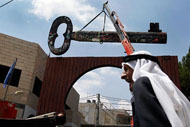
This week Palestinians will commemorate Al Nakba, the catastrophe that befell the Palestinian people when Israel was founded. Every year, Palestinians hang placards pointing to the right of return, they carry keys symbolizing the homes they were forced to leave and could not return to and remember the Palestine that was lost to them 65 years ago.
This year will be no different. Every May 15, Palestinian recall their catastrophe and demand justice. They demand that they are granted the right of return for those who were made refugees virtually overnight and were then relegate to a life they did not choose. But more than anything, they demand recognition of the tragedy that befell them rather than a denial that it ever happened, or worse, that it was of their own making.
It has been 65 years since Israel was established in 1948, which means those who were cast into exile are either very old or have long passed. Those who experienced the Nakba are now few and far between, clinging to those few precious memories of a small garden in front of their house in Jaffa or of the salty smell of the sea in their neighborhood in Haifa. The rest of us are either descendants of these refugees or ordinary Palestinians who feel their cause is our cause because we are one people.
But the Palestinians have made one thing clear. The refugee issue will not die with the last refugee. It is felt nationwide, the loss, the injustice and the fact that those who were forced from their homes have mostly passed, longing for their beloved homes.
We cannot turn back time. What was lost has been altered, destroyed, changed or taken over by Israel’s newcomers. What we can do is hold on to the right to be recognized, for the injustice to be rectified in word and deed and for Palestine to never be lost in our minds or hearts.
Joharah Baker is a Writer for the Media and Information Department at the Palestinian Initiative for the Promotion of Global Dialogue and Democracy (MIFTAH). She can be contacted at mid@miftah.org.