


Most Palestinians were not eligible to vote in the recent Palestinian elections, because they are absentees, in a wide sense of that word. In the end, less than one million Palestinians cast their ballots. Outside Iraq, on the other hand, a small minority of absentees are vigorously encouraged to vote. In this way, and in others, Palestinians are – unwittingly or not – portrayed as a negligible quantity. However, there are in fact nearly eight million Palestinians, including refugees according to the UN definition of that term. They are still a vast majority in and outside Historic Palestine compared to the five million Israeli Jews. But they remain, in the foreseeable future, a fragmented nation.
The Bush administration seems to have forgotten why it went to war in Iraq. Let us remind the reader: in order to rid the country of weapons of mass destruction, and to pre-empt the use of these weapons by the former Iraqi regime. However, it did not find any, and after over one and a half years of vain searching (following over a decade of UN-led searches) – as well as other ‘mistakes’, including a very high civilian death toll and torture scandals – the US government has now come up with a mainly ‘retroactive’ reason for going there: to bring democracy and freedom to Iraq. As Seymour Hersh recently pointed out (The Coming Wars: What the Pentagon Can Now Do in Secret, New Yorker, January 19, 2005), the members of the new Bush administration have been picked to a large extent because of two publicly stated main government policy objectives: to win the war on terrorism and to bring democracy to the Middle East, objectives that were not on the official agenda when the first Bush administration was formed.
Is the democracy pledge a desperate Plan B, or just an exit strategy for the US in Iraq? Time will tell. What can be said now with a fair degree of certainty is that the upcoming Iraqi election will continue being used to justify the war.
As the USA and its coalition partners will claim credit for enabling these elections, whatever the outcome, there will no doubt also be many associations and comparisons made with the Palestinian presidential elections of two weeks ago. The latter have been styled by the west as the first-ever democratic elections in the Arab World. During the next few weeks we are thus likely to hear the following mantras in US government circles and media, and not only there: “We now know that Arabs can hold democratic elections”; “Democracy is spreading in the Middle East”; “We are on the right track: Israel, Palestinian Authority, Iraq, who’s next?”
It would perhaps be both prudent and instructive to reflect on the ideological importance of the Palestinian elections before they are used or abused for such purposes. The question that first comes to mind is: what do the Palestinian and Iraqi elections have in common? Obviously a great deal. Perhaps it is wiser to concentrate on how they differ.
Formally, the Palestinian Authority does not (yet) rule a state, as opposed to the Iraqi interim government. The main reason is that Israel militarily occupies the territory granted the Palestinians by the international community in 1947 and 1967, respectively. But Iraq is also under military occupation, also by powers with overwhelming military strength, so this difference, though formally important, appears to be less than essential. And the occupation troops are not going to be leaving Iraq on January 31. That is for sure. The Iraqi and Palestinian elections are thus both held under conditions of military occupation which severely limit their governments’ sovereignty and independence, and hamper a true democratic process.
The war in Iraq is a high-intensity war with hundreds of thousands of casualties so far. Last Thursday alone saw no less than four suicide attacks and at least 25 deaths. The Israeli-Palestinian conflict, on the other hand, is often referred to as a low-intensity war. But, obviously, this is a mere matter of degree. Tens of deaths have happened in a day here as well. The Israeli army’s ‘Days of Penitence’ operation in Gaza last year is not fundamentally different from the US assault on Falluja this winter. In sum, there have been hundreds of thousands of casualties here too. The ongoing US-led war in Iraq can be extended backwards in time to 1991, the Israeli-Palestinian conflict to 1948. With hindsight, it is hard to say which one is the bloodier conflict.
The main difference between these elections does not seem so dramatic at first glance. Absentee votes did not take place in the Palestinian National Authority presidential elections. In just about every country with elections (whether democratic or not), absentee votes are extended to a minority group of people that remain citizens but are not present in the country during the general elections. With regard to Palestine, however, the majority of people, nearly five million people, are absentees. Many of them have acquired citizenship in other countries, a million in Israel alone. But many are denied citizenship altogether, for instance most of the Palestinian refugees in Lebanon. It would have made democratic and moral sense to let, at least, these stateless people vote in Palestinian elections, especially since Palestine is not yet a state, and also because they belong to no other state. Instead, there was no absentee voting at all in the PNA elections, not even the 8,000 Palestinians held by Israel as prisoners were allowed to vote. The inhabitants of east Jerusalem, however, were given the opportunity to vote with obstacles: Only 6,000 were allowed to vote in their home city, the rest of 125,000 east Jerusalem Palestinians eligible were forced to leave the city to vote. Moreover, the Israelis created “the appearance of an absentee ballot being cast in Jerusalem for sending to a Palestinian state that was ‘somewhere else’. Therefore, voting was carried out only in post offices…” (Gila Svirsky: A Tale of Two Elections, Miftah, January 11, 2005). Little by little, Israel is carrying out a blatant annexation of east Jerusalem in clear contradiction to international law. The voting and campaigning restrictions in east Jerusalem are an ideological and political part of this ongoing and illegal land grab.
The problem of absentee voting has wide connotations. One possibility of interpreting and justifying this peculiarity in Palestinian voting procedure starts from the fact that the vast majority of these refugees have never lived in the West Bank or Gaza. They were born in exile, and so they have no direct knowledge of the political situation. Nevertheless, they are directly affected by the policies and decisions of the new PNA president, and in return they influence PNA policy profoundly. Only yesterday, a senior Israeli official said that only an interim peace deal would be possible with the new PNA president, Mahmoud Abbas, since he holds final status issues such as the right of return of Palestinian refugees too sacrosanct.
On the other side of the ‘fence’, Israelis treat Palestinian refugees as non-existent, their rights as well. As Uri Davis pointed out in his book, ‘Apartheid Israel’ (London: Zed Books, 2003), “[U]nder Israeli law, any Jew throughout the world has the right of immediate immigration to, settlement in and citizenship of the State of Israel after an alleged forced absence of 2,000 years, but the displaced Palestinian Arab refugees of 1948 and their descendants – some four million people today – are denied the same right, in violation of international law and United Nations resolutions, although their [undeniably] forced absence is less than 60 years. The Israeli legislator does not recognize the term ‘refugee’ as far as the Palestinian Arab is concerned.” (pg. 100) Instead, Palestinians are divided into two classes by Israeli law, ‘present’ and ‘absent’. Those who are absent, moreover, have no right to their own property, otherwise a universal and basic human right, which in Israel has been confiscated by the so-called ‘Custodian of Absentees’ Property’, and has been and still is handed out to immigrant Jews instead. According to Davis, absentees are people who do not exist in the eyes of Israeli law.
The class of ‘absentees’ even includes 250,000 Palestinians, a quarter of all Palestinians with Israeli citizenship, who live in the state of Israel, so-called ‘present absentees’ (if this expression does not baffle you, look up ‘oxymoron’ in the dictionary), who also lack the right to their own property under Israeli law. These are people who were internally displaced during the 1948-49 war, the vast majority of them non-combatants, and their descendants. Similarly, Palestinians in Lebanon are not only denied Lebanese citizenship, but work permits and a host of other rights extended to other foreigners.
Although many Palestinians who were not eligible in the PNA elections do have the vote in other countries, they are being discriminated against in many of those other countries, and therefore a dual citizenship option with the possibility of voting in future Palestinian Authority elections would perhaps not be a bad idea. An even better idea would be to implement the Palestinian refugees’ right of return, as international law demands, but Israel refuses to let this happen.
With regard to the title of Uri Davis’ book: The present stage of Palestinian democracy is much more developed than any semblance of democracy that the South African Bantustans ever achieved, but the PNA areas are otherwise Bantustans. The Israelis have been practicing apartheid (oppressive separation) against Palestinians from the very start, from 1948, but the parallels with the crime against humanity perpetrated against a black indigenous majority in South Africa are becoming even more obvious than before in Historic Palestine. According to Yossi Alpher (‘Demography Tops Territory in New Strategic Calculus’, Forward, January 8, 2005), most Israelis now believe that territory does not necessarily provide security (for them), “especially when it [the territory] comes with millions of Palestinians”, and so Israelis now prefer to implement and enforce an oppressive separation (e.g. by means of an illegal wall) that already far exceeds most aspects of South African apartheid in intensity.
It therefore comes closer to ethnic cleansing than South African apartheid ever did, except during the 17th-18th century genocide of Khoikhoi people in the Cape. A new Israeli demographic study, carried out with a far-right agenda, and presently being circulated among US lawmakers and other influential people, states that there as many as 1.5 million Palestinians ‘missing’ from the occupied territories. The Palestinian Authority’s own figure is 3.8 million, but the new ‘study’ claims there are only 2.4. The strategy here is to discourage the creation of a Palestinian state, since Palestinians are allegedly already doomed to minorityhood in Historic Palestine. This strategy implies further conquest, division, expulsion, and killings.
The comparison with Iraq is of no use here. The war there resembles a colonial war of conquest. If present trends continue, Iraq is likely to end up, though, as a neocolonial dependency. In any event, Iraq is not being settled aggressively by invaders from afar who claim it is their home.
In the end, the bewildering situation in which Palestinians now find themselves is in the aftermath of an election in Palestine where only 45 per cent of eligible voters voted under foreign military occupation for a president of a country without sovereignty, and where the vast majority of nationals were not even eligible – an election which is nevertheless hailed in western countries and elsewhere as being the first democratic elections in an Arab country, ever. Paradoxically, they were essentially democratic, thanks to Palestinian and EU and UN efforts, but they were also essentially undemocratic, especially thanks to Israeli efforts.
Believing in Jerusalem
Date posted: May 27, 2013
By Joharah Baker for MIFTAH
Last week, Israel barred a UNESCO fact-finding mission from entering the country, charging that the Palestinians had ‘politicized’ the mission before it had even arrived. The mission was tasked with looking into conditions of historical sites in the Old City of Jerusalem, something Israel apparently found to be very threatening.
Looking at the state of Jerusalem’s eastern sector today, it is understandable why Israel would not want UNESCO or anyone else walking around the Old City, especially the Palestinian-populated parts of it. Because anyone who does, will see the devastation that Israel and its settlers have wreaked on one of the oldest and most beautiful cities in the world.
Excavation works are being conducted in and around the Aqsa Mosque to make way for more Jewish construction at the place where Waqf authorities say Ottoman and Abbasid artifacts have long been tucked away. A Muslim graveyard is being dug up just outside the Old City’s Jaffa Gate, to build – ironically – a museum of tolerance. Today, two stores were forcefully taken over by Jewish settlers in Al Hakari, one of the neighborhoods in the Muslim quarter and every day, it seems that more and more homes are either being demolished by Israeli municipality authorities or being taken over by Jewish settlers.
The “Judiazation” of Jerusalem is a term many Palestinians and Arabs use for what Israel is doing in the city. In a nutshell, it is the long-term plan Israel is gradually carrying out to change the Arab Palestinian character of Jerusalem. This means demolishing old and historical structures, displacing Palestinians, handing over their homes to settlers and trying to erase the Palestinian or Arab history of the city.
The sad truth is that, on the surface, Israel has succeeded in this to a large extent. Pockets of Jewish settlers now live in the heart of Muslim quarters and aim to take over more and more. Sheikh Jarrah, one of the more affluent Palestinian neighborhoods of Jerusalem, is now pierced with Jewish flags waving from homes that have been wrestled from their Palestinian owners, and Israel’s light rail train cuts right down through Palestinian neighborhoods outside of the city center. The train, of course, is not meant to service the Palestinian population but rather to connect Jewish neighborhoods and settlements in the city, but the area confiscated from Shufat and Beit Hanina for its construction simply fell into the plan.
What the UNESCO mission would not have seen even if they made it into the Old City is the overall humiliation that the Palestinian population of Jerusalem must endure on a daily basis because of Israel’s military occupation. Trips to the Israeli ministry of interior must be made just to prove that one lives in the city for fear that their residency rights may be revoked; young Palestinian men are stopped randomly by Israeli soldiers to check their ID cards or just to harass them, and settlers are always given the luxury of maximum security whenever they walk the streets. If settlers want to march through the city, the Palestinians are told to close their shops, are barred for hours from reaching their homes if they run along the path of the march and are always the ones blamed if any kind of confrontation between the two sides breaks out.
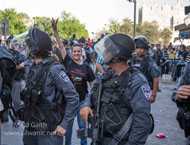
Jerusalem is being squeezed by these measures more and more each day. But there is always that glimmer of hope, that strength that shines through proving that all is not lost. On Shavuot, Israeli settlers and extremists poured into the Old City, singing loudly, banging on the shop doors and waving huge Israeli flags. The sight was disconcerting to say the least. However, the afternoon of that same day, at Damascus Gate, passersby were met with a completely different scene. Palestinian flags waved in determined Palestinian hands under the threatening eye of heavily armed Israeli police and soldiers. The youths were fearless, demanding freedom, with strong, unrelenting voices.
The sight of the Palestinian flag waving at the entrance to Damascus Gate was a breath of fresh air. All is not lost and never will be because hope is eternal and determination and strength come from a never-ending spring.
That day at Damascus Gate is what all Palestinians must keep in their minds’ eye in spite of the daily oppression of the occupation. No matter how many missions Israel bars from entering or how many houses it takes over, there will always be those brave souls who, despite the risks, will always raise Palestine’s flag.
Joharah Baker is a Writer for the Media and Information Department at the Palestinian Initiative for the Promotion of Global Dialogue and Democracy (MIFTAH). She can be contacted at mid@miftah.org.
Let Mohammed rest in peace
Date posted: May 20, 2013
By Joharah Baker for MIFTAH
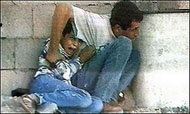
There is no point falling into the pit of countering the claims being made about the death of Mohammed Al Durra, the 12-year old boy from Gaza whose videotaped killing was seen around the world. The boy, crouching in fear behind is equally afraid father as bullets whizzed around them, was killed admittedly by the Israeli army. Later, the army recanted after investigating the tape, saying Durra was killed by Palestinian fire instead. Well now, Israel is changing its story altogether, saying he was not killed at all. In fact, he was probably not even wounded and the French channel that broadcast the footage and brought some pretty bad rap to Israel, had most likely filmed a charade.
The reason why I will not waste my time countering this claim is that even with the great lengths the Israeli government went to to prove that the boy was never killed, it could not provide any irrefutable proof that Mohammed Al Durra – who would be 25 now – is still alive. No pictures, no testimonies, no hospital or morgue officials giving statements to refute his death, have been provided. Only sketchy information about ‘poor quality footage’ and the fact that it seems as though the boy moved his arm after he had slumped over his father following the explosion.
My point is this: indeed, Mohammed Durra’s death was at least one of the catalysts that fueled the second Intifada, and thus, was an important event in the history of the Palestinians. However, more importantly – most importantly to me –is the fact that this is about a boy who died in sheer terror, with his distraught father futilely trying to shelter him from the barrage of bullets coming their way.
Mohammed Al Durra was a boy, with a life, a family and friends. He died a horrible death and now he is being made to die a second one. I did not know Mohammed or his family, but I can only imagine how awful it must be for them to read these claims now and feel the pain of losing their child all over again. If nothing else, this is disrespect for human life of the worst kind.
Some may postulate that the rehashing of the Durra case is a personal jab at the French cameraman who shot the footage, Charles Enderlin. Perhaps. But as a Palestinian who has seen the pain endured by numerous families who receive the horrible news that their sons or daughters have been killed by the Israeli army, my concern is for his family and for his memory. He should be left to rest in peace. If Israel has axes to grind with French journalists or with the international community for holding it accountable for its actions, then so be it. Israel is not lacking in the public relations department.
That being said, there is just one decent thing left to do. Leave Mohammed Al Durra and his memory alone.
Joharah Baker is a Writer for the Media and Information Department at the Palestinian Initiative for the Promotion of Global Dialogue and Democracy (MIFTAH). She can be contacted at mid@miftah.org.
Recognition and justice is our demand
Date posted: May 13, 2013
By Joharah Baker for MIFTAH
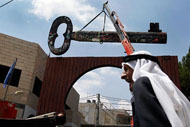
This week Palestinians will commemorate Al Nakba, the catastrophe that befell the Palestinian people when Israel was founded. Every year, Palestinians hang placards pointing to the right of return, they carry keys symbolizing the homes they were forced to leave and could not return to and remember the Palestine that was lost to them 65 years ago.
This year will be no different. Every May 15, Palestinian recall their catastrophe and demand justice. They demand that they are granted the right of return for those who were made refugees virtually overnight and were then relegate to a life they did not choose. But more than anything, they demand recognition of the tragedy that befell them rather than a denial that it ever happened, or worse, that it was of their own making.
It has been 65 years since Israel was established in 1948, which means those who were cast into exile are either very old or have long passed. Those who experienced the Nakba are now few and far between, clinging to those few precious memories of a small garden in front of their house in Jaffa or of the salty smell of the sea in their neighborhood in Haifa. The rest of us are either descendants of these refugees or ordinary Palestinians who feel their cause is our cause because we are one people.
But the Palestinians have made one thing clear. The refugee issue will not die with the last refugee. It is felt nationwide, the loss, the injustice and the fact that those who were forced from their homes have mostly passed, longing for their beloved homes.
We cannot turn back time. What was lost has been altered, destroyed, changed or taken over by Israel’s newcomers. What we can do is hold on to the right to be recognized, for the injustice to be rectified in word and deed and for Palestine to never be lost in our minds or hearts.
Joharah Baker is a Writer for the Media and Information Department at the Palestinian Initiative for the Promotion of Global Dialogue and Democracy (MIFTAH). She can be contacted at mid@miftah.org.