
Factsheet - Fair Tax Monitor 2019-2024
Date posted: February 20, 2025
By MIFTAH
Introduction
The tax system is a financial and economic policy tool through which society's goals and objectives are realized based on its intellectual philosophy and ideology. Thus, the tax system is based on certain economic, social, and political pillars and foundations that differ from one society to another, from one country to another, and in the same country from one stage to another. Taxation has become not only a source of revenue for the state, but also a social and economic function, in addition to its traditional financial function, by becoming one of the economic tools through which economic development can be achieved, addressing inflation and stagnation, redistributing incomes, and raising the standard of living of citizens to advance the national economy in general .
The analytical review of the philosophy of tax systems shows that it is based on social, financial, and economic foundations. Its social function is to redistribute wealth to ensure social justice in the state, and to use tax revenues to achieve social stability and provide social services, and social protection for marginalized, vulnerable, and poor groups. Its financial function is to secure revenues for the state treasury to cover public expenditures, while its economic function is represented by the fact that it is a major tool of the state's fiscal policy, which it uses in order to stimulate economic growth, reduce inflation levels, protect the national economy, or stimulate some economic sectors, by imposing certain taxes, tax cuts, and others.
Based on these foundations and principles, the Palestinian tax system must achieve the philosophy of taxation by maximizing revenues, protecting the national economy, and, most importantly, achieving and enforcing social justice for all social groups . And responding to gender issues.
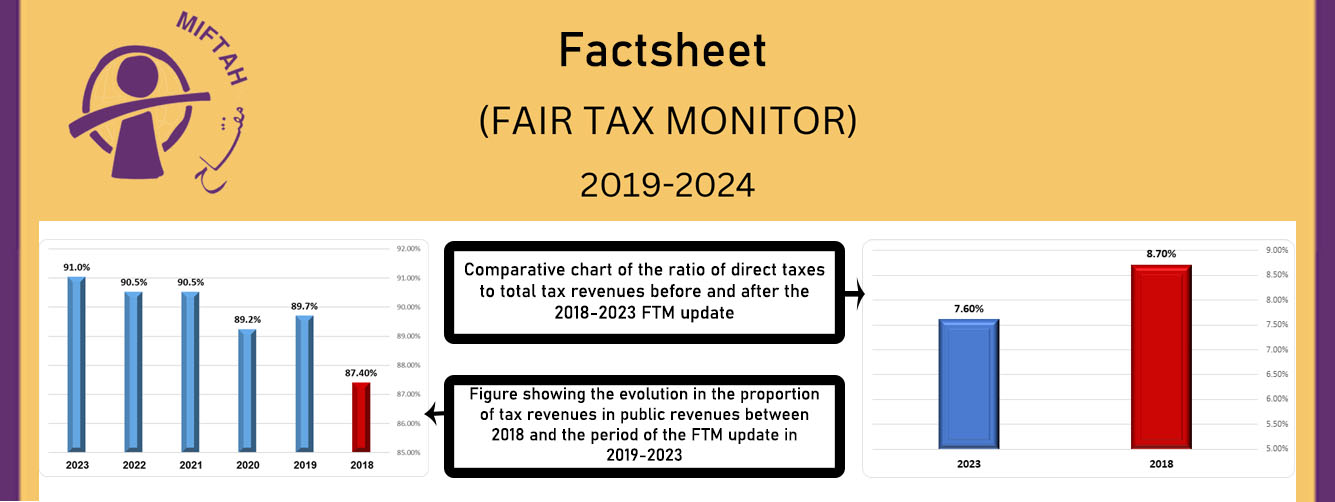
In 2024, the FairTax Monitor-FTM in the Palestinian Territories was updated, complementing the previous monitor’s data, which was published in 2018. The current update focuses on the years 2019-2024 and presents a set of conclusions and facts, the most important of which are:
To view the Full Factsheet as PDF
Factsheet on the status of Palestinian digital rights for CSOs and consequences of the genocide
Date posted: January 15, 2025
By MIFTAH

As part of its work in the field of public and digital diplomacy to expand global communication outreach in support of the Palestinian cause, MIFTAH conducted an assessment survey on the cognitive capabilities of civil society organizations (CSO) in the West Bank, including Jerusalem and the Gaza Strip, on digital rights and its implementation.
This survey reflects the complex reality of digital rights in occupied Palestine and assesses how prepared CSOs are in dealing with growing digital challenges, especially after the 2023 genocide. The survey sheds light on the gaps in digital knowledge and the infrastructure for digital security, which is a particular challenge, hampering the ability of institutions to protect their data and effectively carry out their role.
The survey is based on the descriptive methodology, including questionnaires from 55 institutions in the West Bank (including Jerusalem) and the Gaza Strip, in addition to in-depth interviews with six digital rights, women’s and other institutions working in the Gaza Strip. The qualitative data was analyzed using advanced tools such as Nvivo and SPSS.
Overview
According to the outcomes of the survey, CSOs target various sectors, with women being the most targeted sector at 43.6%, followed by children, at 16.4%, the elderly at 12.7% and youth at 10.9%. Meanwhile, persons with disabilities were targeted at 9.1% and media persons at 7.3%. Furthermore, the results of the survey showed that 34.5% of CSOs target all sectors indiscriminately, thus reflecting the comprehensiveness of the sample.
The scope of the work of Palestinian institutions is distributed within the districts as follows: Ramallah, at 50.9% of institutions, Hebron, at 40%, Jerusalem at 34.5% and Nablus at 38.2%. It also extends to the Bethlehem, Jenin, Tulkarm and Salfeet governorates at 29.1% each and the northern Jordan Valley at 32.7%, Jericho and the Jordan Valley at 27.3% and Qalqilya at 25.5%.
In the Gaza Strip, the work of CSOs in northern Gaza stood at 40%, Khan Younis at 29.1% Gaza City at 40%, Rafah at 25.5% and Deir Al Balah at 27.3%.
The locations of Palestinian CSO included in the survey were distributed among cities, camps and villages, with the majority of CSOs concentrated in cities, at 74.5%. Villages were the headquarters of 16.4% of the institutions while only 9.1% were based on camps. This distribution reflects the urban concentration of CSOs and highlights the need for increased presence in rural areas and in camps, to promote inclusiveness and access to marginalized and vulnerable sectors.
The size of Palestinian CSOs participating in this survey varied in terms of the number of employees. The survey showed that 27.3% of institutions include from one to 10 employees, while 16.4% have 11 to 15 employees. The largest majority of CSOs, 41.8% had between 16 and 30 employees while only 14.5% of institutions had over 31 employees. This distribution reflects the variety in size of CSOs, with most institutions either small or medium size, which is compatible with the survey sample.
To view the full Factsheet as PDF
Sexual violence as a weapon of genocide
Date posted: October 09, 2024
By MIFTAH
Background
Since the beginning of its illegal occupation in 1967, Israel has detained over 1 million Palestinians, who are tried in Israeli military courts with a conviction rate close to 100%. Israel also detains Palestinians with no charge or trial for an indefinite period under so-called “administrative detention”. This policy of mass arbitrary arrest is one of the tools used to maintain Israel's illegal occupation, apartheid regime and settler-colonial project.
To date, over 10,400 Palestinians have been arbitrarily arrested since October, 2023. The conditions of Palestinian prisoners have significantly deteriorated since the beginning of the Israeli genocide in Gaza, and imprisoned Palestinians are being subjected to torture, starvation, violent cell raids, including with tear gas, deliberate medical negligence, denial of food, water, sanitary pads and sanitation, as well as denial of lawyers and family visits.
Despite the absolute prohibition of torture and ill-treatment under international law, Israeli occupation forces and prison authorities employ various torture and ill-treatment techniques against almost all Palestinian political prisoners and detainees, including women and children, leaving grave physical and psychological damage. Israeli prison authorities, occupation forces and interrogators feel emboldened to commit such acts of torture with full impunity, knowing that neither the complicit Israeli legal system nor the international community will hold them accountable.
While sexual violence against Palestinian women and men has long been a tactic of torture at Israeli military checkpoints, during raids on their own homes and inside prisons, it has rapidly increased since the start of the genocide in Gaza. Palestinian women are often hesitant to share such stories, in fear of the associated social stigma, something which Israel exploits, and also due to the belief that Israel’s crimes will go unpunished.
Access the full factsheet here.