

Before her murder by the Israeli army, Rachel Corrie referred almost casually to the conditions at a refugee camp in Gaza as being beset by “ambient gunfire” [1]. Today the problem isn’t necessarily the gunfire, but it is the “ambient death and destruction”. In fact, Palestinian death has become so routine that it simmers at a level not meant to enter “Western” consciousness at all. It has been a long time now since we even saw the names of Palestinian victims in The New York Times or similar newspapers, but now even death as a statistic is disappearing. If anyone wonders how terrible mass crimes occurred in the past and no one intervened, then Israel’s relentless dispossession of the Palestinians provides a case study in how this happens.
Some Statistics
A brief perusal of the usual newspapers reveals that most don’t mention the daily death toll in the Occupied Palestinian Territories (OPT). It is only when the Israeli Occupation Forces (IOF) engage in some particularly egregious act that there may be some mention, but it disappears in a matter of days. As long as the death toll remains below a magical threshold, it is not deemed important enough to bother Western readers with deaths happening elsewhere. The regularity of the death toll indicates that this is something that the IOF may be exploiting on purpose. The statistics reveal that some very sinister and criminal acts are perpetrated against the Palestinians regularly, and it is a chronic condition. The graphs below aim to give a better perspective of what is happening on the ground and what is the true nature of the occupation.
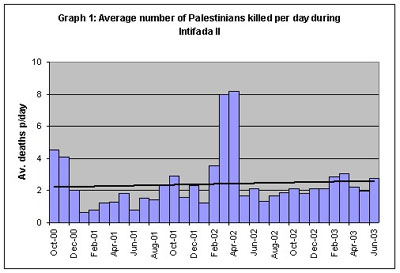
Graph #1 shows the average number of killings per day during the course of the intifada. At the beginning of the intifada, about two Palestinians were killed every day, but now this has steadily increased to 2.6 p/day (see trend line). There have been some spikes, e.g., during the destruction of Jenin (Apr. 2002) when the average killings reached 8.2 p/day [2]. NB: these numbers do not include the resistance fighters (yes, lets dispense with the tainted word “militants”) killed by the IOF. The average killings for June 2003 stand as of June 16th at 3.4 p/day; this is the death toll after the Road Map negotiations were launched. Even without scaling this up to the implied death toll in a larger US population, these numbers would easily have caused outrage and would have been found intolerable in the US. When it happens elsewhere and where it suits the Israelis, then death can be ignored. Chomsky and Herman call victims of friendly state terror “undeserving” victims, those whose plight is not deemed important enough to appear in the newspapers of record like the NYT. In the current context, it is clear that Palestinians are “undeserving” victims. [Data Source]
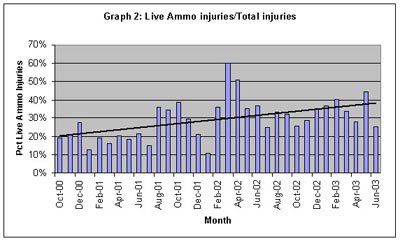
Graph #2 shows the percentage of injuries caused by live ammunition, and it shows a clear upward trend. The use of “plastic or rubber” bullets has declined and Israeli repression has become more lethal. Today in Gaza, Israeli snipers arbitrarily shoot Palestinians of all ages and often claim victims.
This graph also shows several declines in the “live ammo ratio”, for example in June 2003. The explanation for this is that during this period most of the injuries are from helicopter gunship attacks on the refugee camps – during the so-called targeted killings. These attacks occur in densely populated refugee camps and bystanders are often killed or injured – on occasion, e.g., in Khan Yunis on Oct. 7, 2002, even bystanders were targeted. The NYT will refer to these injuries as “caught in the crossfire” if they are mentioned at all.
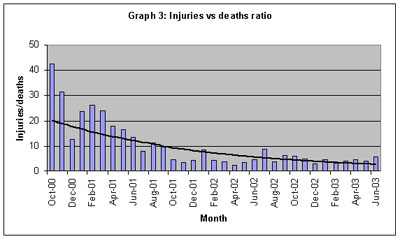
Graph #3 shows the ratio of the number of injuries to the number of fatalities per month. This has gone from 43 to about five injuries per fatality in the course of the intifada. This reflects the changing nature of the resistance against the Israeli occupation, and the changing nature of the IOF’s response to the Palestinian resistance. At the beginning of the intifada, large numbers of Palestinian youngsters would confront the army – many of them would be injured, and today there are tens of thousands of Palestinians maimed by an array of lethal weaponry. These days, large demonstrations confronting the army are rare occasions – people do get tired of being killed or maimed. But a more sinister, and perhaps realistic interpretation is that the Israeli army is more determined to kill directly. This is certainly supported by Graph #1, which shows a steady increase in the death rate. Graph #2 is even more blunt: it shows that the IOF’s tactics have changed decisively; the use of rubber/plastic bullets has given way to live ammunition aimed at the head or torso – the way most people are killed today. However, it is a serious mistake to think that the innocuous sounding “plastic” bullets are meant only for crowd control. These bullets have a zinc and glass core enveloped in a plastic coating – these are plastic coated bullets. Within the first 100 meters, these bullets are faster than “high velocity” regular bullets, and therefore the impact of these “plastic” bullets is catastrophic to the victim. Another pernicious aspect of the plastic bullets is that soldiers feel less inhibited using them.
Just to make sure you know…
The IOF has a proclivity of shooting ambulances, abusing medical staff and ambulance personnel. If any proof is needed, see Daymon Hartley’s photo of Israeli soldiers beating paramedics when they came to rescue a wounded youngster.
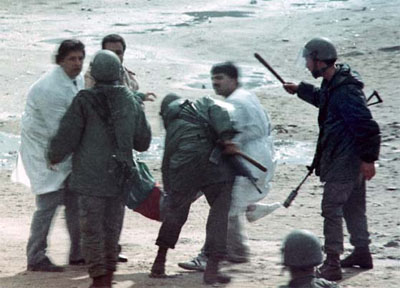
Caption: Israeli soldiers beat health workers who are attempting to transport an injured
Palestinian youngster. Jabalya refugee camp, Gaza during intifada #1. Photo: ©daymonjhartley.com.
| Since the beginning of intifada through June13, 2003 | |
| Total attacks on ambulances | 253 |
| Total ambulances damaged | 118 |
| Total personnel injured | 192 |
| Total ambulance personnel killed | 3 |
| Denial of access to ambulances logged | 920 |
Source: PRCS; www.palestinercs.org
And we thought things couldn’t get worse…
We may be lulled into thinking that the situation in the Occupied Territories may improve now that President Bush has officially launched the “road map” negotiations. However, at the same time the IOF is doing its best to eliminate witnesses to its actions from the OPT. That is, it is becoming increasingly difficult for volunteers to witness and to resist the actions of the IOF. All foreigners are finding it increasingly difficult to enter the OPT. If things were about to improve, then why is the IOF so intent on removing potential witnesses?
There they go again!
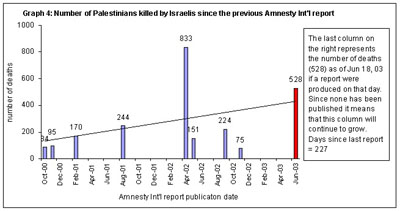
Amnesty International, the Mother Theresa of Human Rights organizations, is notorious for its long spells of silence and meek statements about Israel/Palestine. Graph #4 shows the number of days and number of deaths since the previous report, e.g., as of June 18th it has been 227 days since its previous report and there have been 528 killings since then [3]. Given the severe, massive and flagrant abuse of human rights, it would seem incumbent on Amnesty to highlight the situation. It is troubling to find that there is an upward trend in the number of fatalities between reports. That is, given the chronic and severe nature of the situation one would expect to find constant monitoring, and thus a proportional number of reports. Also given the very large number of Palestinians imprisoned without charges, trial, and for indefinite periods, it is remarkable to find only a handful of Palestinian cases that Amnesty asks its volunteers to do anything about. Whereas one finds a long list of Cuban “prisoners of conscience”, there are only two Palestinians found in this category [4].
>
Amnesty is also strangely silent on the de facto abrogation of the Fourth Geneva Conventions by the US and Israel. Although there hasn’t been a formal declaration by the Americans or Israelis that the Geneva Conventions are no longer operative, it is clear from the actions of both countries that the Geneva Conventions are being routinely flouted. Israel has violated all but one of the Geneva Conventions provisions.
AI’s latest press release (June 5, 03) is better than most, and therein one finds: “The Israeli and Palestinian sides have a duty to respect fundamental rights, regardless of whether or not they are engaged in a peace process. Their obligation to abide by international law must not rest on the implementation of such a process or on other political considerations. […] Both sides are bound by the principles of international human rights and humanitarian law which prohibit the killing of civilians.” Amnesty continues to postulate equal responsibility for the conflict and its consequences. Never mind that Israel is the occupying power and has specific obligations under the Geneva Conventions. The same report also states: “Taking concrete measures to end such abuses, some of which constitute war crimes and crimes against humanity is a requirement of international law and cannot be made conditional to the implementation of the ‘roadmap’ or other political processes…”. Off hand, this seems like a clear statement, but it highlights Amnesty’s propensity of not proffering clearly directed condemnations or accusations. In most instances, Amnesty gives the impression that the accusation of war crimes may apply to both Israelis and Palestinians; again neglecting the fact that Israel is the occupying power. Finally, the far more serious crime: “crime against humanity” has never been leveled clearly against Israel, this accusation only appears clearly when referring to Palestinian violence [5].
(For a further discussion of Amnesty see: Say It Isn’t So)
The undeserving underdog
Despite the fact that the situation on the ground for the Palestinians is desperate, and that they have endured decades long occupation and dispossession of their land, it is remarkable to find legions of apologists willing to whitewash Israeli actions on many levels. The list of offending aspects of media discourse that apologist groups pursue is surprising, and a web search reveals many such pressure groups. It is curious that some groups attack any portrayal of Palestinians as victims and a portrayal of their victimhood as different from that of Israelis. They rail against weighing the death of a Palestinian by IOF violence differently from the death of an Israeli killed by a Palestinian. In their jargon, they are objecting to an “immoral equivalence”. They want Israel to be considered the victim, and if this fails, then in the very least they equate the moral standing of Israelis to that of Palestinians. When a Palestinian has been portrayed as a victim these apologists lobby/harass media in order to obtain “balance”.
In all likelihood, they have successfully lobbied Amnesty on this issue, because it equates the nature of the violence perpetrated against Israelis and Palestinians. That is, AI will condemn to the same degree when an Israeli or a Palestinian is killed. It also calls on “both parties to respect human rights...”. Prof. Honderich’s answer to this is revealing: “Everyone should object to the terrible “even-handedness” of such statements as the Amnesty one. Everyone should choke on such attempts at “balance”. In an ordinary sense of the words, there is no place at all for even-handedness and balance in actually dealing with the rapist engaged in the rape of the woman with a knife at her throat. The rapist has no rights that bear significantly on the question of whether he should stop or be stopped. The analogy with Israel is not a wild one, but exact.” [6]
Moral turpitude
People once asked how genocide could happen without sparking mass outrage. Yet there is no mystery as to why there is virtually no reaction. We’ve witnessed many sordid events in the recent past like the genocide in Rwanda, and it barely disrupted the liberals’ cocktail parties -- it even engendered a new term: compassion fatigue. June 5th marked the 36th year of occupation of the West Bank and Gaza, the relentless and gradual campaign to drive the Palestinians off the land. Scores are killed every month, even more are wounded or maimed, and several houses demolished every day. A grotesque eight meter high wall is being built that has all to do with quartering what little land could form the basis of a negotiated solution. NB: this is not a fence. The wall isolates tens of thousands of Palestinians from neighboring villages – again, a ploy to drive even more people off the land, and this includes Palestinians living in what is now Israel. As Jeff Halper, the coordinator of the Israeli Committee Against House Demolitions, recently stated: “the bulldozers are working 24 hours a day” [7], and we are talking about 500+ bulldozers [12]. So, horrible things can happen to millions of people, yet instead of moral outrage we encounter the classic three-monkey hear-see-say no-evil situation.
Meanwhile, there are some sanctimonious weasels busy looking the other way or chastising others for raising their voices. The king of the pack is perhaps Elie Wiesel, the professional holocaust survivor. He is not willing to witness or say anything about what is happening to the Palestinians, and when confronted with the dubiousness of his stance he squirms out stating that it is not up to him to criticize Israel. What Wiesel preaches has all to do with the “cult of remembrance” – an inert look at history that doesn’t draw the crucial lessons that can be carried forward in a universal manner. People like him risk trivializing the lessons of history, and to transform the message from one dealing with the lessons of the holocaust to one only dealing with the hollow-caust.
Last year Jonathan Sacks, London’s chief rabbi, uttered a meek statement about the Palestinians. That is, he stated that the occupation was having morally corrosive effects on Israeli Jews; interestingly, he didn’t mention what was being done to the Palestinians. As soon as he had uttered it, he faced some criticism, and retracted his statement forthwith [8]. Never mind, a month later, he was lobbying Tony Blair, the British prime minister, to quash criticism of Israel at universities around the UK. Here is someone barely willing to raise his own voice lobbying the prime minister to censor speech at universities across the UK. If one wonders how the Church kept quiet about the Nazis, then one only has to look at these moral frauds to see why. A singular unwillingness to raise their voices about the daily outrages is the main part of the problem; ingratiating themselves with those in power is the other part of the problem.
Cherie Blair, the British prime minister’s wife, is an intelligent woman and a lawyer, but one rarely hears any statement coming from her. However, last year when referring to the Palestinians she stated: “As long as young people feel they have got no hope but to blow themselves up, you are never going to make progress.” A barrage of criticism immediately ensued from the right wing and pro-Israeli press in the UK, and Tony Blair’s office retracted this statement the next day without an explanation. Blair, who is portrayed as church-going, moral (is passionate about moral issues), and “blue eyed”-sincere, retracted his wife’s meek statement. The only fault of the statement was that it helps understand why people engage in desperate actions. As soon as one attempts to understand the causes of violence, then one also humanizes the Palestinians. But that crossed the line -- it is simply unacceptable to the pro-Israeli apologists. A more important question arises pertaining to Tony Blair’s action. As Jack Straw, the foreign minister, recently acknowledged: “a lot of problems we are having to deal with now are a consequence of our colonial past” and “… it is not an entirely honorable history”. If Blair is not willing to stand by the meekest statement his wife has made, then how can we expect him to side with the Palestinians to obtain meaningful negotiations let alone uphold some meaningful principles? Alas, Tony Blair is more concerned about his image in the right wing press than in standing up for principles and paying an historical debt to the Palestinian people [9].
An interesting case study of corporate morals is that of Caterpillar. One should visit Caterpillar’s website to admire the “Social Responsibility” section, or to view its extended “code of conduct” – obviously they have gone through the motions of incorporating business ethics into their corporate ethos (at least the website). While upholding these lofty ideals, Caterpillar is still willing to supply the 60-ton D9 and D11 armored bulldozers that are wreaking havoc in the occupied territories [10]. Every day these bulldozers demolish several houses on the flimsiest of pretexts or with no justification at all [11], they flatten and uproot more olive groves or orchards, and in general, Caterpillar has a hand in creating mass misery and destruction. Caterpillar also supplies some of the key equipment required to build the hideous 1,000km-long and 8m-high wall [12] – its equipment is creating a wall to imprison an entire people in the 21st century.
Caterpillar also has on its conscience the murder of Rachel Corrie. A Caterpillar bulldozer crushed her while she was trying to defend a house. Perhaps Glen A. Barton, Caterpillar’s Chairman & CEO, may want to discuss the social responsibility of his company’s support of Sharon’s bloody enterprise. However, the shareholders’ meetings are closely guarded events, and emails/letters to company representatives are never answered. One can only suspect that Mr. Barton will not allow a bit of conscience stand in the way of some profit. The least Caterpillar can do is to remove the grossly hypocritical social responsibility section from its website.
The moral turpitude of many players, especially in the US, makes the occupation of Palestinian land possible, and guarantees the continued dispossession of masses. Many provide the intellectual backing for this enterprise, others extort the funding from the American taxpayer, hordes of apologists bully the media, and a plethora of companies provide the tools. Alas, it is unlikely that the legions of hypocrites will bear the consequences of any revenge by the dispossessed or those maligned for so many decades. Their violence will elicit from this same rotten gang the hollers of “terrorism” and similar disingenuous accusations. There is no violence without a cause, and for once one would hope our American friends would at least consider their responsibility in this long tragic episode. There is a singular need to stop the US bankrolling of the Israeli enterprise.
Associated with the ambient death in Palestine is an ambient fetid stench. And it surrounds us.
Notes
[1] “I asked Rachel [Corrie] what the nightly situation was like in Brazil camp. ‘Oh, theirs is a good deal of ambient gunfire usually. But nothing much,’ she casually described it.”
-- Ben Granby, Nightmare in Rafah, CounterPunch March 7, 2003.
[2] Note that there never was an official and independent investigation of the number of Palestinians killed at the time of the Jenin massacre. Palestinians were killed in large numbers not only in Jenin, but elsewhere too. The death toll for this period may never be known because the UN was not permitted to investigate by Israel. Amnesty Int’l or Human Rights Watch’s reports on the Jenin event aren’t conclusive and speculate on the total number of fatalities and casualties. Both these organizations have had a dubious past, with a proclivity to whitewash all that Israel does, and therefore theirs cannot be taken as a final statement of what happened in Jenin and how many people were killed.
[3] Only the reports pertaining Palestinian human rights were included here. Its reports on the abuse of Israeli human rights was excluded. The reason for this is simple: this author thinks that it is inadmissible to equate the violation of the human rights of the occupier with those of the occupied/victim. In contrast, both Amnesty and HRW equate the human rights of both occupied/occupier.
[4] Amnesty’s website has only two references (MDE 15/047/2001; MDE 15/31/2001) to Palestinian Prisoners of conscience (POC), and there are a two “possible prisoners of conscience” (MDE 15/112/2002; MDE 15/082/2001;MDE 15/093/2002). For someone to be classed as a POC they must not be implicated in violence, association with certain groups, or even voicing a desire to resist occupation. There are many Palestinians rotting in jail now for the simple fact that they are community leaders, they are held arbitrarily, with no charges or trial, and often held for arbitrary sentences. For the most part, these people don’t feature anywhere in AI’s literature or campaigns.
[5] For example, Without Distinction, July 2002; stated in AI’s usual cautious way [referring to the Palestinians]: “… such violations meet the definition of crimes against humanity under international law.”
[6] See an interview with Ted Honderich.
[7] Jeff Halper stated that the aim of Sharon is to integrate the West Bank into Israel, to make this irreversible, and the “bulldozers are working 24 hours a day” to implement this plan. Statement made at a talk in London on May 29, 2003.
[8] This interview contains his statement: “You cannot ignore a command that is repeated 36 times in the Mosaic books: ‘You were exiled in order to know what it feels like to be an exile.’ I regard that as one of the core projects of a state that is true to Judaic principle. And therefore I regard the current situation as nothing less than tragic, because it is forcing Israel into postures that are incompatible in the long-run with our deepest ideals.” Yes, that is it! Please note that rabbi Sacks sent a letter to The Guardian retracting this statement (confirmed by Jonathan Freedland, the author of the Guardian article). This is not the first time Sacks has retracted a statement, but has done so a few times in the past (e.g., see Recantation).
[9] Tony Blair and his spinmeisters are particularly keen to appear in a good light in the right wing press, and in particular, in Murdoch-owned tabloids. The tabloids are a pernicious institution that debases anything we ever thought about the press. It is also ironic that a Labour prime minister, putatively on the Left, is defended by the right wing press and criticized by the centrist and left-wing press.
[10] The D9 weighs 47.2 tons, it is 3.9 m high and has a blade 1.8 m high and 4.2 m long, and it costs US$500,000. A newer version the D9R weights 50+ tons. However, the Israelis add several tons of armor plating to the D9 increasing its weight to about 60 tons. The D11 is an even larger monster – a large sized SUV fits comfortably in its blade. Caterpillar gets US$1.2m for each D11. The US taxpayer is most likely the one who foots the bill.
[11] See Amira Hass: We don't raze homes for no reason.
[12] Ran Ha’Cohen, The Apartheid Wall, DissidentVoice, May 21, 2003. This is an important article, and it provides a map that enables one to appreciate the scale and nature of this project. Note that the reported length of this wall changes every month – to accommodate the latest whims of Sharon & Co., to incorporate the latest punitive measure entering the planner’s head, or to cater to the wishes of the friendly settlers.
[Data Source] The data is available on the Palestinian Red Crescent Society website. It contains many reports and up to date statistics. One note though: there is a data gap in March/April 2002, at the height of the Israeli attack on Jenin and elsewhere. It means that the number of fatalities and casualties are actually understated. For the purposes of this report the gaps were zeroed out.
Also important is Neve Gordon’s, Land Theft & Confinement: The Bad Fence, CounterPunch, May 30, 2003. The best overview of the wall is Meron Rappaport’s On Israel’s Separation Fence. “…on any given day has 500 bulldozers at work, paving and building one of the largest projects in the history of the country, perhaps the largest.”
Paul de Rooij is an economist living in London and can be reached at proox@hotmail.com (NB: all attachments will be automatically deleted.)
Palestinian Misery in Perspective
Date posted: July 28, 2004
By Paul de Rooij
This article first appeared on www.dissidentvoice.org on June 5, 2004
The media usually focuses on the latest casualty and quickly forgets those who died even a few days before. The American media in particular has a Dracula-like predilection for warm bodies, and no interest in cases where blood has already dried. Unfortunately this ahistoric focus on the last victim hides the scale of mass crimes and the responsibility of various perpetrators. Whether in Iraq, Palestine, Colombia, or Haiti, it is necessary to locate human rights abuses in a wider context to appreciate the scale of what is occurring on the ground.
In the case of Palestinian casualties, it is all too evident that CNN, BBC, and most other major media are mostly interested in today's casualties: they seem to studiously ignore precedents, and above all, they will not refer to the pattern of killings as systematic in nature. Of course, admitting that such killings are systematic would imply that Israel is committing “crimes against humanity”, a precursor to genocide. When the media seeks to whitewash “friendly” mass crimes, there is a tendency to fixate on specific instances to the exclusion of broad patterns. Even when a pattern of killings and other abuses is chronic and systematic, the BBC/CNN will tend to focus on specific cases without reference to broader trends. When referring to Palestinian conditions, what we find is that reports of casualties, house demolitions, and dispossession in these media outlets pertain to specific cases and not to general patterns. [1] Incidentally, the opposite is true when there is an incident of Palestinian violence; here lists and charts are available to highlight their context.
The chosen context can be used to obfuscate the reality on the ground. The tools at the media's disposal can be likened to an instrument of variable magnification ranging from a wide-angle lens to a telescope. Informative journalism requires using the most appropriate level of magnification for the story under investigation. On the other hand, propaganda requires contextual blurring and the use of inappropriate tools. Thus, it is best to use a telescope to view the stars, and clearly, a wide-angle lens is the wrong tool. In the case of Palestinian casualties, it is evident that the mainstream media are intent on presenting news using a telescope (preferably out of focus), when a wide-angle lens should be used.
The tables and graphs below put the Palestinian casualty toll into perspective over the course of the second intifada. These graphs speak for themselves, revealing a pattern that is all too evident. These graphs are meant to fill a gap in the available data pertaining to the casualty toll during the second intifada.
Average death tolls and an interpretation
During the course of the second intifada, the average number of Palestinians killed stands at 2.26 per day. The total killed between September 29, 2000 and May 31, 2004 is 3,023. To interpret these numbers one must scale these figures to make them comparable to understand what they would mean in the context of our own countries. This is the purpose of the table below.
|
Average and total Palestinian fatalities during intifada II,
Sep. 29, 2000 — May 31, 2004. Actual and population scaled numbers |
||||
|---|---|---|---|---|
| Av. Fatalities/day | Total fatalities | scale factor | Population size (m) | |
| Palestine | 2.26 | 3,023 | 1 | 3.7 |
| US | 177 | 236,938 | 78 | 290.0 |
| UK | 37 | 49,022 | 16 | 60.0 |
| Spain | 25 | 32,844 | 11 | 40.2 |
| Explantion: | ||||
| Column (1) The average fatalities per day for the Palestinians is an actual number. The numbers below this have been scaled using the scale factor in column #3. | ||||
| Column (2) is analogous to column #1, but refers to the total fatalities. | ||||
| Column (3) is the scaling factor derived from the population numbers in column #4 | ||||
An average daily fatality rate of 2.26 would proportionally equate to 177 deaths per day in the US. Similarly, the total Palestinian fatalities of 3,023 would equate to 236,938 in the US. One wonders how Americans would react if they experienced such a fatality rate, i.e., they would suffer a 9-11 death toll every two weeks. One suspects that there would be a level of mass hysteria, and rightly so. Actually, Americans are prone to suffer from mass hysteria with far less provocation. The Washington DC snipers killed ten and wounded three during a three-week “killing spree”; this is relatively minuscule when compared with the Palestinian experience. However, the media stoked a level of mass hysteria about these killings; Americans were even afraid to fill up their SUVs at the gas station — heavens! Americans are entitled to their hysteria about sniper killings, but then they should be aware that they finance the Israel military machine and support Ariel Sharon to the hilt, and therefore they have direct responsibility in the killing of 2.26 Palestinians per day (on average), something that would translate to 177 deaths per day in their society. While in the US such numbers would be abhorrent, when it comes to Palestine, Americans even provide the bullets and untold billions of dollars in funding. While the US justifies “preventive” wars, the abrogation of democracy, etc., after suffering 3,000 fatalities during 9-11, it lambastes and demonizes a brutalized Palestinian population which is suffering a death toll that is several orders of magnitude higher in terms of a scaled fatality rate.
Before anyone objects to the use of these scaled numbers, consider that Israel has frequently used such statistics for its own ends – referring exclusively to Israeli casualties. [2]
Average fatalities per month
Graph 1 plots the average death toll per month during the second intifada. It has fluctuated depending on Sharon's willingness to play along with “peace processes” and temporarily alternating with his proclivities to demolish Palestinian hopes for an independent state. Thus during the attack on the West Bank in April 2002, about eight Palestinians were killed every day. [3] While it was convenient for Sharon to play along with the Aqaba peace negotiation appearances, only 0.3 Palestinians were killed per day – the lowest level during the intifada.
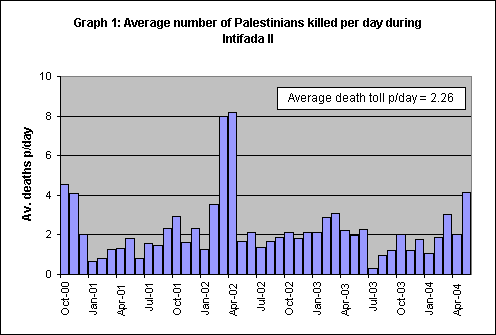
What is also evident is the escalation of the fatality rate after July
2003. After the Aqaba summit, it was not possible to obtain any
meaningful negotiations due to the inexorable building of the land-grab
wall. Inevitably, the on-going ethnic cleansing and dispossession gave
rise to an increasing death toll. From the graph it seems that the
Israeli military increase the level of dispossession or killings in a
gradual fashion. If they can get away with killing four Palestinians per
day now, then we can expect a gradual increase in the following months.
While killings, destruction, and dispossession remain under a magic
threshold level, the media will not consider this to be “news”. Even
human rights organizations aren't much bothered if the killings remain
below this threshold. Of course, if some egregious killings take place,
then Amnesty International, the Mother Theresa of the human rights
organizations, will suggest that the killings “were not proportionate”,
and occasionally it will utter a condemnation. Killings under the magic
threshold are presumably “proportionate” and thus can be ignored.
And the wounded
Even when the mainstream media will say something about fatalities, the wounded are mostly ignored. However, consider that Israel uses heavy-duty battlefield weaponry against a mostly defenseless population in densely populated civilian neighborhoods, where the effect of these weapons on their victims is devastating. Even the so-called non-lethal bullets create harrowing wounds; even tear gas can be fatal or cause permanent lung damage. There are tens of thousands of wounded with permanent disabilities: blindness, paraplegia, as well as loss of limbs. These numbers are staggering, and a tremendous burden for a society already on the edge.
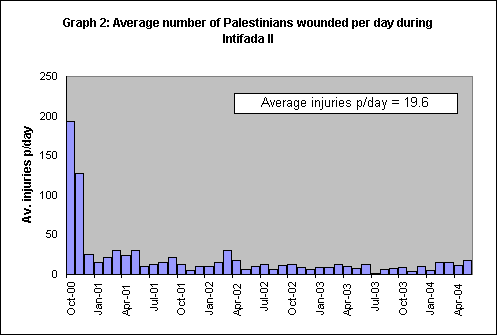
The average number of injured Palestinian victims stands at 19.6 per
day (the US scaled equivalent would be 1,540). This number includes
victims shot with military high velocity bullets, the so-called plastic
or rubber bullets, tear gas and other unidentified gases with
neurological effects, helicopter gunfire, and other large military
ordnance. One must also remember that at the beginning of the
intifada 193 Palestinians were injured on average every day. The
Israeli army used millions of bullets during the first month of the
intifada – and their effects were all too evident. [4]
The nature of the wounds
While at the beginning of the intifada a significant percentage of the casualties were shot with so-called non-lethal bullets, the ratio of casualties due to this type of weaponry has fallen significantly. It is increasingly rare to find Israeli soldiers using “plastic bullets” (in reality plastic-coated-bullets); the predilection today is to use “high-velocity bullets”. Graph 3 shows that the percentage of injuries due to “live ammunition” has increased steadily. In other words, this implies that the use of “non-lethal” bullets/weapons has fallen over time. However, the graph hides some increasing trends. Someone wounded by a missile fired by an Apache helicopter enters the “other” category, and hence it doesn't register as “live ammunition”. The reason why the “live ammo” ratio has fallen during the past few months is directly attributable to wounds caused by helicopter or tank fire. The graph (not shown) with the “other” category as a ratio of total injuries shows a steady increase.

Injuries and deaths
Injuries and deaths
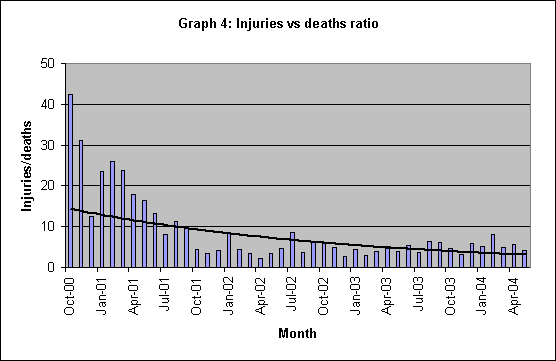
Graph 4 shows the number of injuries in relation to deaths over the same period. Thus at the beginning of the intifada there were a large number of injuries for each fatality, and this ratio has fallen steadily. The reason behind the dropping trend is the changing nature of the confrontation. Whereas at the beginning there were many popular demonstrations with a large number of ensuing wounded victims, this has steadily given way to sniper fire, helicopter or tank fire. The latter is more lethal, and the resulting ratio of injuries to fatalities tends to be lower. A reduction in this ratio sometimes implies an increase in the lethality of the Israeli tactics: they are increasingly shooting to kill.
Interference with medical treatment
A clear crime committed against Palestinians is the destruction of ambulances, abuse of ambulance staff, and the impediment of access to medical treatment. The summary statistics during the intifada are the following:
|
Obstruction and destruction of ambulances in Palestine. Data refers to the second intifada up to May 28, 2004 |
|
|---|---|
| Attacks on ambulances to date | 302 |
| Total ambulances damaged | 126 |
| Total ambulance personnel injured | 198 |
| Total ambulance personnel killed | 12 |
| Denial of access to ambulances (recorded instances) | 1,376 |
| Number of ambulances damaged beyond repair | 28 |
| Source: Palestine Red Crescent Society | |
The Palestine Red Crescent Society, keeps meticulous statistics and it is worth studying this graph. If one found that the most of the damage occurred during the April 2002 attack, then maybe this would be understandable. However, the recurrent pattern is a steady interference and destruction of Palestinian ambulances; the graph makes this very clear. Even though a so-called peace process was kicked off in July 2003, the level of ambulance destruction continued unabated. One could easily imagine the howls of indignation and disgust if Palestinians were to shoot up an Israeli ambulance or just impede its access. However, destruction of these increasingly important vehicles, or even their commandeering by the Israeli military is a media nonevent.
Is it Genocide?
It is evident that Israel under Ariel Sharon is pursuing relentless campaign that aims to drive the Palestinians off the land and dispossess an ever-greater number of people. The construction of the wall is proof that this policy is being implemented. Driving armored Caterpillar bulldozers through refugee camps obviously entails a casualty toll. Similarly, the usually violent suppression of the demonstrations against this policy conjures its own grim statistics. From the graphs we detect a pattern: the repression is systematic and gradually increases the severity of its methods – this is especially apparent after July 2003. In Ariel Sharon's calculus, and with American blessing, the dispossession and repression of the Palestinians can continue as long as it is performed gradually with a slowly increasing rate. So, mass abuses are occurring in the occupied territories today; these are chronic, and indeed systematic. When the scale, intent and period are taken into account, then one can only conclude that Israel's policy is genocidal. [5]
Please note that this is not a conclusion that could only have been reached recently. In December 2, 2000, Francis Boyle, a professor of International Law at Univ. Illinois, Urbana-Champaign, stated:
I am sure we can all agree that Israel has indeed perpetrated the international crime of genocide against the Palestinian People. [6]
So, who will take responsibility for blowing the whistle and classifying Israeli actions as genocide? Unfortunately, this has to be determined by the UN Commission on Human Rights or the General Assembly, and the legal basis for the classification of genocide is the UN convention against Genocide. [7] There are numerous obstacles before the UN will take any action because of this arrangement. Via a private communication with senior UN personnel, we discover that there has been no movement whatsoever at the UN to determine if Israel's policies are genocidal, confirming that the UN's role in preventing genocide is hopeless. It is very likely that the UN will not move at all regarding Palestine.
The explanation for the UN's inaction has much to do with the US's role at the UN; this has been less than constructive, and it will pressure member countries to avoid issuing a “genocide” warning. [8] One only has to remember the US efforts prior to February 2004 to block the International Court of Justice's hearings on the land-grab wall; to defend its client it attempted to obstruct this international legal body. Furthermore, the UN convention against genocide is very narrowly defined and it is almost the case that genocide can only be determined after the fact. The convention almost guarantees that there will be no action to prevent genocide or stem an on-going genocide. Finally, the insufferable Kofi Annan is known for his callousness and inaction in the face of mass slaughter. As head of UN peacekeeping forces during the Rwandan genocide, he was instrumental in delaying and obstructing UN action. As Michael Hourigan, a UN war crimes investigator in Rwanda, stated: “consistently, repeatedly people like Kofi Annan failed to act.” And the UN's Carlson Commission, an internal inquiry about the Rwandan genocide, actually blamed Kofi Annan and the unit he led. [9] Annan's record of inaction bodes ill for the UN to engage in any action to lend international protection to the Palestinians, a population that has been brutalized for many decades.
Further reading
-
Francis Boyle, Palestine Should Sue Israel for Genocide before the International Court of Justice, MediaMonitors, December 2, 2000.
-
Ward Churchill, A Little Matter of Genocide, City Lights Books, 1997.
-
Linda Polman, We did nothing: Why the truth doesn't always come out when the UN goes in, Penguin Viking 2003.
-
Paul de Rooij, Ambient Death in Palestine, DissidentVoice, June 21, 2003.
Paul de Rooij can be contacted at proox@hotmail.com (NB: all attachments will be deleted automatically). ©2004 Paul de Rooij
Data Sources
The data used in this article originates from the
Palestinian Red Crescent Society – with one small modification
discussed below. This is a high quality database and the origin of its
data is from the PRCS hospitals and medical staff. The numbers are
conflict-related deaths and injuries, which includes all Palestinian
killed or injured irrespective of cause. PRCS numbers are closely
related to the Health Ministry numbers, but they are not the same. The
Palestine Authority is now publishing its numbers on its website, and
data quality has improved over time. The PA's statistics can be found
here. Finally, the
Palestine Monitor also publishes good quality data and can be
found
here. The total casualty numbers of these three sources are not
equal, yet there is only a minor discrepancy. Part of the reason for the
discrepancy has to do with the reported numbers during the April 2002
attack. In many instances, there was no access to hospitals, victims
were buried without adequate record keeping, or victims were removed by
the Israeli army. PRCS's approach has been to zero out most of the
entries of this period, and thus understates the total casualty figures.
The Palestine Monitor has imputed some numbers to this period based on
interviews with residents and victim exhumations. The approach taken in
this article was to use Palestine Monitor data for the months that were
zeroed out by PRCS. This makes a difference of 19 fatalities.
Endnotes
[1] The opposite also happens. That is, if confronted by a particularly
egregious Israeli crime, this can be whitewashed by placing it in a
wider context. Alternatively, Israeli actions can be juxtaposing with
Palestinian violence – thus the Israelis are only responding.
[2] See
Israel's Campaign of Misinformation, The Palestine Monitor,
January 14, 2004.
[3] Please note that the statistical record during the April 2002
military assault on the West Bank is incomplete. For example, not
withstanding the UN or Amnesty International reports, it is not known
how many people were killed in Jenin or the West Bank during this month.
NB: Because the investigation was vetoed by the US, there was no
in-depth investigation of the killings in Jenin.
[4] Source: Raji Sourani, Lawyer and Director of the Palestinian Center
for Human Rights in Gaza. Data provided during his “The worst yet to
come from Occupied Palestine” lecture in London, October 11, 2002.
[5] Mass killings don't need to occur before mass abuses can be classed
as genocide. See Ward Churchill, A Little Matter of Genocide,
City Lights Books, 1997, pp. 399 – 444.
[6] Francis Boyle,
Palestine Should Sue Israel for Genocide before the International Court
of Justice, MediaMonitors, December 2, 2000.
[7] The official name of the convention is: The International Convention
on the Prevention and Punishment of the Crime of Genocide, UN, 1948.
[8] In the late 1940s, the US sought to wreck and postpone the UN
convention on genocide. It managed to have the principal architect of
the convention (Raphael Lemkin) removed; it then reduced the scope of
the convention thereby eliminating its effectiveness in preventing
future genocides. Even after wrecking the convention, the US didn't
ratify it but delayed until 1988 when it gave a conditional
ratification, and ratified it only after adding many provisos that
rendered the convention toothless. For an excellent discussion of the
American machinations surrounding the convention see Ward Churchill,
A Little Matter of Genocide, City Lights Books, 1997, pp. 363 – 393.
[9] Judi Mcleod, “One minute for 100 days of Rwandan hell”,
CanadaFreePress.com, April 5, 2004. Also important: Per Ahlmark, “UN
chief's career clouded”, The Australian, May 3, 2004. Finally, this
article also contains important info: Max Teichman, “UN: Kofi Annan and
the Rwanda genocide,” NewsWeekly, April 24, 2004.