

|
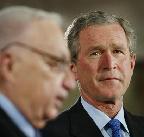
Israel's prime minister, Ariel Sharon, is fond of flaunting his connections in the White House, and the remarkable closeness of his relationship with President George Bush. The fruits of that friendship were on full view yesterday when Mr Sharon emerged from his talks at the White House with a letter from the American president endorsing Israel's unilateral withdrawal from the Gaza Strip, while retaining control of the majority of the West Bank. Nearly 15 years after the first President Bush established the idea under the Madrid accords that peace in the Middle East was impossible unless the Palestinians were brought into the equation, his son appeared yesterday to have lost faith in the idea of a negotiated peace between Israel and its closest Arab neighbour. The contours of Gaza - and possibly the West Bank - would now be dictated by Israel. The change of heart was widely credited to Mr Sharon, who persuaded Mr Bush that Yasser Arafat's inability or unwillingness to end Palestinian suicide bombings made him an enemy in the global war on terror. "The Bush administration seems to have accepted the Sharon premise that there is no partner for negotiations," said Philip Wilcox, a former US consul general in Jerusalem and the president of the Foundation for Middle East Peace. "It offers commitments to Israel without any corresponding commitments to the Palestinians, which I think is unwise." The territorial dispensation was not the only milestone victory for Mr Sharon. In his statement yesterday Mr Bush rejected the guiding principle of the Palestinians for the last five decades: the right of return of refugees. The American president also redefined the state department description of Jewish settlements as "obstacles to peace". In a sense, the double diplomatic coup confirms what has been evident to observers of the Israeli-Palestinian process for months. With the Bush administration distracted by events in Iraq, Mr Sharon has been able to dictate his terms. "Sharon took a step in many ways that was revolutionary for him in the withdrawal from Gaza. He is showing real leadership, and when you have a leadership vacuum, the leader that has a plan is going to prevail," said Edward Walker, a former US ambassador to Israel. "There no American leadership in the process, and certainly I don't see leadership among the Palestinians." But for all his success on American soil Mr Sharon has a struggle ahead of him. On May 2 he is due to present his proposals for a withdrawal from Gaza for the approval of his rebellious Likud party. He needed the White House benediction. "Sharon must come home with some assurance that the United States does not see it as a first step towards evacuation of most of the settlements," said Menachem Klein of the Jerusalem Institute for Israel Studies. "He also wants to be able to say that Washington will back him if he wants to use Apache helicopters to fire on the Gaza Strip after the pull-out." However, the boost to Mr Sharon caused almost immediate anger and dismay in the Arab world, and could complicate Washington's relations with the rest of the region. "The United States may lose its status, or what remains of its status, as an honest broker," said Mr Klein. "It will be very difficult for them. It may also make some problems with Hosni Mubarak in Egypt." Instead yesterday's events will probably confirm the suspicion that the US shares Mr Sharon's opinion that a settlement with the Palestinians can only be imposed, not negotiated. That may lead to repercussions months or even years from now, but in this election season the White House has other considerations. Mr Bush is in dire need of a foreign policy success as the costs of America's invasion of Iraq escalate. With no end in sight to an insurrection that has begun to inflict heavy casualties on US military forces and the entire project in Iraq, Washington finds it prudent to fall back on a reliable ally: Israel. Mr Sharon has also succeeded in wearing down the administration's qualms about the wall he is building through the West Bank by making a few adjustments to the route. Washington also decided not to penalise Israel by deducting loan guarantees - unlike last year when the wall cost the Jewish state $300m (£170m). Meanwhile Mr Sharon's aides brought US officials around to Israel's vision for the West Bank, sketching out a division of land in which Israel would retain control of large swaths of territory, and the Palestinians would be confined to isolated pockets. At the beginning of this month the talk was that Israel would retain three West Bank outposts. On Monday night, Mr Sharon raised the stakes to the five largest Jewish settlement blocks. However, Mr Bush appeared unperturbed. Yesterday he appeared to have shed almost all of his reservations about Mr Sharon's vision for the Middle East, calling his plan a historic opportunity, and urging the Palestinians to see it as a first step towards a state. It seems highly unlikely that the Palestinians will agree. Related Articles
By: MIFTAH
Date: 14/04/2004
×
US Endorses Israel's Occupation
A substantial and dangerous shift in U.S. policy in the Middle East took place this afternoon in the White House. US President George W. Bush explicitly endorsed Israeli Prime Minister Ariel Sharon’s plans to permanently maintain major Israeli settlements in the West Bank (which are illegal under international law and comprise 15% of the whole territory), while denying 4.6 million Palestinians (refugees who were uprooted, dispossessed, and displaced in 1948) their right to return to their original homes in historical Palestine (Israel). Bush applauded Sharon’s moves as “historic and courageous actions,” giving his full backing to the “unilateral disengagement” plan and presenting Sharon with a letter of “assurances.” The letter, signed by President Bush, awards retroactive legitimacy to Israel's illegal settlements by stating:
Further, and in violation of UN Resolution 194, the letter blatantly rejects the inalienable right of return for Palestinian refugees by stating:
President Bush’s statement and letter trumps two pillars of US policy towards the Israeli – Palestinian conflict, namely that Israeli settlements on occupied Palestinian land are an obstacle to peace and that the U.S. will not dictate the terms of a final peace settlement. Moreover, this shift in policy makes the US complicit in the Israeli occupation's lawlessness and violation of international law, ultimately disregarding essential legal foundations such as the 4th Geneva Convention of 1949, which strictly prohibits the occupying power from making demographic changes in, and moving parts of its population into, the territory it occupies. By fully accommodating Sharon and his shortsighted extremist government, the US is preempting key issues intended for mutual agreement between the Palestinians and Israelis within the framework of the final status negotiations; the US has abandoned its very own “road map” to peace. Sharon has undoubtedly exploited the US predicament in Iraq and Bush’s election drive to extort concessions and changes in US policy towards the Palestinian-Israeli conflict. More dangerously, the Bush administration’s publicly declared endorsement of Sharon’s plans is a clear demonstration of Washington’s willful neglect of the real causes of conflict (most notably Israel’s illegal occupation of the Palestinian territories). The imminent and long term effects of such a negligent shift in policy will be destructive to the whole region; the results of today’s declarations will further inflame Arab and Islamic public opinion. It will most certainly undermine what is left of US standing in the region, destroying both its credibility and any chance it still has of playing a constructive role in peace-making. The position adopted by the US this evening worryingly shows a complete disregard for the Palestinians in the negotiations concerning their future. America has forcefully assumed the position of deciding the fate of the Palestinian people during exclusive and secretive negotiations with Israel. Dispensing with Palestinian rights, Sharon’s plan received unfettered support from Bush, who foolishly expected Palestinians to embrace their new found “freedom,” despite the fact that Israel will maintain full control of airspace, territorial waters, and land passages of the West Bank and Gaza. The US has effectively given Sharon a green light to retain at the very least six "large settlement blocs" in the West Bank, with a population of 92,500 Israeli settlers, if not more, as part of any final peace accord with the Palestinians. Sharon promised that the Jewish settlements inside Hebron and the nearby enclave of Kiryat Arba, as well as Maaleh Adumim, Givat Ze'ev, Ariel and Gush Etzion “will remain under Israeli control and that will continue to grow stronger and develop.” Today, the prospects for a real peace settlement between the Palestinians and the Israelis seem more distant than ever. By: CNN

Date: 14/04/2004
×
Transcript of Bush, Sharon Statements
WASHINGTON -- President Bush met Wednesday at the White House with Israeli Prime Minister Ariel Sharon and praised Sharon's proposed withdrawal from Gaza and parts of the West Bank. The Palestinians object to a provision in the plan, which would allow Israel to retain control of six blocs of Jewish settlements in the West Bank. Following is a transcript of statements by Bush and Sharon after their meeting. BUSH: I'm pleased to welcome Prime Minister Sharon back to the White House. For more than 50 years, Israel has been a vital ally and a true friend of America. I've been proud to call the prime minister my friend. I really appreciate our discussions today. The policy of the United States is to help bring peace to the Middle East and to bring hope to the people of that region. On June 24, 2002, I laid out a vision to make this goal a reality. We then drafted the "road map" as the route to get us there. The heart of this vision is the responsibility of all parties -- of Israel, of the Palestinian people, of the Arab states -- to fight terror, to embrace democracy and reform, and to take the necessary steps for peace. Today, the prime minister told me of his decision to take such a step. Israel plans to remove certain military installations and all settlements from Gaza and certain military installations and settlements from the West Bank. These are historic and courageous actions. If all parties choose to embrace this moment, they can open the door to progress and put an end to one of the world's longest-running conflicts. Success will require the active efforts of many nations. Two days ago I held important discussions with President [Hosni] Mubarak of Egypt, and I will soon meet with King Abdullah of Jordan. We're consulting closely with other key leaders in the region, in Europe and with our quartet partners: the E.U., Russia and the United Nations. These steps can open the door to progress toward a peaceful, democratic, viable Palestinian state. Working together we can help build democratic Palestinian institution as well as strong capabilities dedicated to fighting terror so that the Palestinian people can meet their obligations under the road map on the path to peace. This opportunity holds great promise for the Palestinian people to build a modern economy that will lift millions out of poverty, create the institutions and habits of liberty, and renounce the terror and violence that impede their aspirations and take a terrible toll on innocent life. The Palestinian people must insist on change and on a leadership that is committed to reform and progress and peace. We will help, but the most difficult work is theirs. The United States is strongly committed and I am strongly committed to the security of Israel as a vibrant Jewish state. I reiterate our steadfast commitment to Israel's security and to preserving and strengthening Israel's self-defense capability, including its right to defend itself against terror. The barrier being erected by Israel as a part of that security effort should, as your government has stated, be a security rather than political barrier. It should be temporary rather than permanent, and therefore not prejudice any final status issues, including final borders. And this route should take into account, consistent with security needs, its impact on Palestinians not engaged in terrorist activities. In an exchange of letters today and in a statement I will release later today, I'm repeating to the prime minister my commitment to Israel's security. The United States will not prejudice the outcome of final status negotiations and matters for the parties. But the realities on the ground and in the region have changed greatly over the last several decades, and any final settlement must take into account those realities and be agreeable to the parties. The goal of two independent states has repeatedly been recognized in international resolutions and agreements, and it remains a key to resolving this conflict. The United States is strongly committed to Israel's security and well-being as a Jewish state. It seems clear that an agreed, just, fair and realistic framework for a solution to the Palestinian refugee issue as part of any final status agreement will need to be found through the establishment of a Palestinian state and the settling of Palestinian refugees there rather than Israel. As part of a final peace settlement, Israel must have secure and recognized borders which should emerge from negotiations between the parties in accordance with U.N. Security Council Resolutions 242 and 338. In light of new realities on the ground, including already existing major Israeli population centers, it is unrealistic to expect that the outcome of final status negotiations will be a full and complete return to the armistice lines of 1949, and all previous efforts to negotiate a two-state solution have reached the same conclusion. It is realistic to expect that any final status agreement will only be achieved on the basis of mutually agreed changes that reflect these realities. I commend Prime Minister Sharon for his bold and courageous decision to withdraw from Gaza and parts of the West Bank. I call on the Palestinians and their Arab neighbors to match that boldness and that courage. All of us must show the wisdom and the will to bring lasting peace to that region. Mr. Prime Minister, welcome to the White House. SHARON: Thank you. I want to thank you, Mr. President, for your warm welcome and your strong support and friendship for the state of Israel. I came to you from a peace-seeking country. Despite the repeated terror attacks against us, the people of Israel continue to wish for the achievement of a viable peace in accordance with our Jewish tradition, as outlined by Israel's prophets. Our people desire to be known for its achievement in the fields of culture, science and technology, rather than in the battlefield. We are committed to make any effort to develop our country and society for our own benefit and for the benefit of the peoples of the region. In our meeting today, I presented to you the outlines of my disengagement plan. It will improve Israel's security and economy, and reduce friction and tension between Israelis and Palestinians. My plan will create a new and better reality for the state of Israel. And it also has the potential to create the right conditions to resume negotiations between Israel and the Palestinians. I was encouraged by your positive response and your support for my plan. In that context, you handed me a letter that includes very important statement regarding Israel security and its well-being as a Jewish state. You have proven, Mr. President, your ongoing, deep, and sincere friendship for the state of Israel and to the Jewish people. I believe that my plan can be an important contribution to advancing your vision, which is the only viable way to achieve peace and security in the Middle East. I wish to end with a personal note. I, myself have been fighting terror for many years, and understand the threats and cost of terrorism. In all these years, I have never met a leader as committed as you are, Mr. President, to the struggle for freedom and the need to confront terrorism wherever it exists. I want to express my appreciation to you for your courageous leadership in the war against global terror, and your commitment and vision to bring peace to the Middle East. Thank you, Mr. President. BUSH: Thank you, Mr. Prime Minister. Good job, good job. By: George W. Bush
Date: 14/04/2004
×
Letter from President Bush to Prime Minister Sharon
April 14, 2004
His Excellency
Thank you for your letter setting out your disengagement plan. The United States remains hopeful and determined to find a way forward toward a resolution of the Israeli-Palestinian dispute. I remain committed to my June 24, 2002 vision of two states living side by side in peace and security as the key to peace, and to the roadmap as the route to get there. We welcome the disengagement plan you have prepared, under which Israel would withdraw certain military installations and all settlements from Gaza, and withdraw certain military installations and settlements in the West Bank. These steps described in the plan will mark real progress toward realizing my June 24, 2002 vision, and make a real contribution towards peace. We also understand that, in this context, Israel believes it is important to bring new opportunities to the Negev and the Galilee. We are hopeful that steps pursuant to this plan, consistent with my vision, will remind all states and parties of their own obligations under the roadmap. The United States appreciates the risks such an undertaking represents. I therefore want to reassure you on several points. First, the United States remains committed to my vision and to its implementation as described in the roadmap. The United States will do its utmost to prevent any attempt by anyone to impose any other plan. Under the roadmap, Palestinians must undertake an immediate cessation of armed activity and all acts of violence against Israelis anywhere, and all official Palestinian institutions must end incitement against Israel. The Palestinian leadership must act decisively against terror, including sustained, targeted, and effective operations to stop terrorism and dismantle terrorist capabilities and infrastructure. Palestinians must undertake a comprehensive and fundamental political reform that includes a strong parliamentary democracy and an empowered prime minister. Second, there will be no security for Israelis or Palestinians until they and all states, in the region and beyond, join together to fight terrorism and dismantle terrorist organizations. The United States reiterates its steadfast commitment to Israel's security, including secure, defensible borders, and to preserve and strengthen Israel's capability to deter and defend itself, by itself, against any threat or possible combination of threats. Third, Israel will retain its right to defend itself against terrorism, including to take actions against terrorist organizations. The United States will lead efforts, working together with Jordan, Egypt, and others in the international community, to build the capacity and will of Palestinian institutions to fight terrorism, dismantle terrorist organizations, and prevent the areas from which Israel has withdrawn from posing a threat that would have to be addressed by any other means. The United States understands that after Israel withdraws from Gaza and/or parts of the West Bank, and pending agreements on other arrangements, existing arrangements regarding control of airspace, territorial waters, and land passages of the West Bank and Gaza will continue. The United States is strongly committed to Israel's security and well-being as a Jewish state. It seems clear that an agreed, just, fair, and realistic framework for a solution to the Palestinian refugee issue as part of any final status agreement will need to be found through the establishment of a Palestinian state, and the settling of Palestinian refugees there, rather than in Israel. As part of a final peace settlement, Israel must have secure and recognized borders, which should emerge from negotiations between the parties in accordance with UNSC Resolutions 242 and 338. In light of new realities on the ground, including already existing major Israeli populations centers, it is unrealistic to expect that the outcome of final status negotiations will be a full and complete return to the armistice lines of 1949, and all previous efforts to negotiate a two-state solution have reached the same conclusion. It is realistic to expect that any final status agreement will only be achieved on the basis of mutually agreed changes that reflect these realities. I know that, as you state in your letter, you are aware that certain responsibilities face the State of Israel. Among these, your government has stated that the barrier being erected by Israel should be a security rather than political barrier, should be temporary rather than permanent, and therefore not prejudice any final status issues including final borders, and its route should take into account, consistent with security needs, its impact on Palestinians not engaged in terrorist activities. As you know, the United States supports the establishment of a Palestinian state that is viable, contiguous, sovereign, and independent, so that the Palestinian people can build their own future in accordance with my vision set forth in June 2002 and with the path set forth in the roadmap. The United States will join with others in the international community to foster the development of democratic political institutions and new leadership committed to those institutions, the reconstruction of civic institutions, the growth of a free and prosperous economy, and the building of capable security institutions dedicated to maintaining law and order and dismantling terrorist organizations. A peace settlement negotiated between Israelis and Palestinians would be a great boon not only to those peoples but to the peoples of the entire region. Accordingly, the United States believes that all states in the region have special responsibilities: to support the building of the institutions of a Palestinian state; to fight terrorism, and cut off all forms of assistance to individuals and groups engaged in terrorism; and to begin now to move toward more normal relations with the State of Israel. These actions would be true contributions to building peace in the region. Mr. Prime Minister, you have described a bold and historic initiative that can make an important contribution to peace. I commend your efforts and your courageous decision which I support. As a close friend and ally, the United States intends to work closely with you to help make it a success. Sincerely,
Read More...
By: Amira Hass
Date: 27/05/2013
×
Slain Bedouin girls' mother, a victim of Israeli-Palestinian bureaucracy
Abir Dandis, the mother of the two girls who were murdered in the Negev town of Al-Fura’a last week, couldn't find a police officer to listen to her warnings, neither in Arad nor in Ma’ale Adumim. Both police stations operate in areas where Israel wants to gather the Bedouin into permanent communities, against their will, in order to clear more land for Jewish communities. The dismissive treatment Dandis received shows how the Bedouin are considered simply to be lawbreakers by their very nature. But as a resident of the West Bank asking for help for her daughters, whose father was Israeli, Dandis faced the legal-bureaucratic maze created by the Oslo Accords. The Palestinian police is not allowed to arrest Israeli civilians. It must hand suspects over to the Israel Police. The Palestinian police complain that in cases of Israelis suspected of committing crimes against Palestinian residents, the Israel Police tend not to investigate or prosecute them. In addition, the town of Al-Azaria, where Dandis lives, is in Area B, under Palestinian civilian authority and Israeli security authority. According to the testimony of Palestinian residents, neither the IDF nor the Israel Police has any interest in internal Palestinian crime even though they have both the authority and the obligation to act in Area B. The Palestinian police are limited in what it can do in Area B. Bringing in reinforcements or carrying weapons in emergency situations requires coordination with, and obtaining permission from, the IDF. If Dandis fears that the man who murdered her daughters is going to attack her as well, she has plenty of reason to fear that she will not receive appropriate, immediate police protection from either the Israelis or the Palestinians. Dandis told Jack Khoury of Haaretz that the Ma’ale Adumim police referred her to the Palestinian Civil Affairs Coordination and Liaison Committee. Theoretically, this committee (which is subordinate to the Civil Affairs Ministry) is the logical place to go for such matters. Its parallel agency in Israel is the Civilian Liaison Committee (which is part of the Coordination and Liaison Administration - a part of the Civil Administration under the Coordinator of Government Activities in the Territories). In their meetings, they are supposed to discuss matters such as settlers’ complaints about the high volume of the loudspeakers at mosques or Palestinians’ complaints about attacks by settlers. But the Palestinians see the Liaison Committee as a place to submit requests for permission to travel to Israel, and get the impression that its clerks do not have much power when faced with their Israeli counterparts. In any case, the coordination process is cumbersome and long. The Palestinian police has a family welfare unit, and activists in Palestinian women’s organizations say that in recent years, its performance has improved. But, as stated, it has no authority over Israeli civilians and residents. Several non-governmental women’s groups also operate in the West Bank and in East Jerusalem, and women in similar situations approach them for help. The manager of one such organization told Haaretz that Dandis also fell victim to this confusing duplication of procedures and laws. Had Dandis approached her, she said, she would have referred her to Adalah, the Legal Center for Arab Minority Rights in Israel, which has expertise in navigating Israel’s laws and authorities.
By: Phoebe Greenwood
Date: 27/05/2013
×
John Kerry unveils plan to boost Palestinian economy
John Kerry revealed his long-awaited plan for peace in the Middle East on Sunday, hinging on a $4bn (£2.6bn) investment in the Palestinian private sector. The US secretary of state, speaking at the World Economic Forum on the Jordanian shores of the Dead Sea, told an audience including Israeli president Shimon Peres and Palestinian leader Mahmoud Abbas that an independent Palestinian economy is essential to achieving a sustainable peace. Speaking under the conference banner "Breaking the Impasse", Kerry announced a plan that he promised would be "bigger, bolder and more ambitious" than anything since the Oslo accords, more than 20 years ago. Tony Blair is to lead a group of private sector leaders in devising a plan to release the Palestinian economy from its dependence on international donors. The initial findings of Blair's taskforce, Kerry boasted, were "stunning", predicting a 50% increase in Palestinian GDP over three years, a cut of two-thirds in unemployment rates and almost double the Palestinian median wage. Currently, 40% of the Palestinian economy is supplied by donor aid. Kerry assured Abbas that the economic plan was not a substitute for a political solution, which remains the US's "top priority". Peres, who had taken the stage just minutes before, also issued a personal plea to his Palestinian counterpart to return to the negotiations. "Let me say to my dear friend President Abbas," Peres said, "Should we really dance around the table? Lets sit together. You'll be surprised how much can be achieved in open, direct and organised meetings."
By: Jillian Kestler-D'Amours
Date: 27/05/2013
×
Isolation Devastates East Jerusalem Economy
Thick locks hug the front gates of shuttered shops, now covered in graffiti and dust from lack of use. Only a handful of customers pass along the dimly lit road, sometimes stopping to check the ripeness of fruits and vegetables, or ordering meat in near-empty butcher shops. “All the shops are closed. I’m the only one open. This used to be the best place,” said 64-year-old Mustafa Sunocret, selling vegetables out of a small storefront in the marketplace near his family’s home in the Muslim quarter of Jerusalem’s Old City. Amidst the brightly coloured scarves, clothes and carpets, ceramic pottery and religious souvenirs filling the shops of Jerusalem’s historic Old City, Palestinian merchants are struggling to keep their businesses alive. Faced with worsening health problems, Sunocret told IPS that he cannot work outside of the Old City, even as the cost of maintaining his shop, with high electricity, water and municipal tax bills to pay, weighs on him. “I only have this shop,” he said. “There is no other work. I’m tired.” Abed Ajloni, the owner of an antiques shop in the Old City, owes the Jerusalem municipality 250,000 Israeli shekels (68,300 U.S. dollars) in taxes. He told IPS that almost every day, the city’s tax collectors come into the Old City, accompanied by Israeli police and soldiers, to pressure people there to pay. “It feels like they’re coming again to occupy the city, with the soldiers and police,” Ajloni, who has owned the same shop for 35 years, told IPS. “But where can I go? What can I do? All my life I was in this place.” He added, “Does Jerusalem belong to us, or to someone else? Who’s responsible for Jerusalem? Who?” Illegal annexation Israel occupied East Jerusalem, including the Old City, in 1967. In July 1980, it passed a law stating that “Jerusalem, complete and united, is the capital of Israel”. But Israel’s annexation of East Jerusalem and subsequent application of Israeli laws over the entire city remain unrecognised by the international community. Under international law, East Jerusalem is considered occupied territory – along with the West Bank, Gaza Strip and Syrian Golan Heights – and Palestinian residents of the city are protected under the Fourth Geneva Convention. Jerusalem has historically been the economic, political and cultural centre of life for the entire Palestinian population. But after decades languishing under destructive Israeli policies meant to isolate the city from the rest of the Occupied Territories and a lack of municipal services and investment, East Jerusalem has slipped into a state of poverty and neglect. “After some 45 years of occupation, Arab Jerusalemites suffer from political and cultural schizophrenia, simultaneously connected with and isolated from their two hinterlands: Ramallah and the West Bank to their east, West Jerusalem and Israel to the west,” the International Crisis Group recently wrote. Israeli restrictions on planning and building, home demolitions, lack of investment in education and jobs, construction of an eight-foot-high separation barrier between and around Palestinian neighbourhoods and the creation of a permit system to enter Jerusalem have all contributed to the city’s isolation. Formal Palestinian political groups have also been banned from the city, and between 2001-2009, Israel closed an estimated 26 organisations, including the former Palestinian Liberation Organisation headquarters in Jerusalem, the Orient House and the Jerusalem Chamber of Commerce. Extreme poverty Israel’s policies have also led to higher prices for basic goods and services and forced many Palestinian business owners to close shop and move to Ramallah or other Palestinian neighbourhoods on the other side of the wall. Many Palestinian Jerusalemites also prefer to do their shopping in the West Bank, or in West Jerusalem, where prices are lower. While Palestinians constitute 39 percent of the city’s population today, almost 80 percent of East Jerusalem residents, including 85 percent of children, live below the poverty line. “How could you develop [an] economy if you don’t control your resources? How could you develop [an] economy if you don’t have any control of your borders?” said Zakaria Odeh, director of the Civic Coalition for Palestinian Rights in Jerusalem, of “this kind of fragmentation, checkpoints, closure”. “Without freedom of movement of goods and human beings, how could you develop an economy?” he asked. “You can’t talk about independent economy in Jerusalem or the West Bank or in all of Palestine without a political solution. We don’t have a Palestinian economy; we have economic activities. That’s all we have,” Odeh told IPS. Israel’s separation barrier alone, according to a new report by the United Nations Conference on Trade and Development (UNCTD), has caused a direct loss of over one billion dollars to Palestinians in Jerusalem, and continues to incur 200 million dollars per year in lost opportunities. Israel’s severing and control over the Jerusalem-Jericho road – the historical trade route that connected Jerusalem to the rest of the West Bank and Middle East – has also contributed to the city’s economic downturn. Separation of Jerusalem from West Bank Before the First Intifada (Arabic for “uprising”) began in the late 1980s, East Jerusalem contributed approximately 14 to 15 percent of the gross domestic product (GDP) in the Occupied Palestinian territories (OPT). By 2000, that number had dropped to less than eight percent; in 2010, the East Jerusalem economy, compared to the rest of the OPT, was estimated at only seven percent. “Economic separation resulted in the contraction in the relative size of the East Jerusalem economy, its detachment from the remaining OPT and the gradual redirection of East Jerusalem employment towards the Israeli labour market,” the U.N. report found. Decades ago, Israel adopted a policy to maintain a so-called “demographic balance” in Jerusalem and attempt to limit Palestinian residents of the city to 26.5 percent or less of the total population. To maintain this composition, Israel built numerous Jewish-Israeli settlements inside and in a ring around Jerusalem and changed the municipal boundaries to encompass Jewish neighbourhoods while excluding Palestinian ones. It is now estimated that 90,000 Palestinians holding Jerusalem residency rights live on the other side of the separation barrier and must cross through Israeli checkpoints in order to reach Jerusalem for school, medical treatment, work, and other services. “Israel is using all kinds of tools to push the Palestinians to leave; sometimes they are visible, and sometimes invisible tools,” explained Ziad al-Hammouri, director of the Jerusalem Centre for Social and Economic Rights (JCSER). Al-Hammouri told IPS that at least 25 percent of the 1,000 Palestinian shops in the Old City were closed in recent years as a result of high municipal taxes and a lack of customers. “Taxation is an invisible tool…as dangerous as revoking ID cards and demolishing houses,” he said. “Israel will use this as pressure and as a tool in the future to confiscate these shops and properties.”
By the Same Author
Date: 03/03/2007
×
The Bush Conversion: How the President Saw the Light and Changed Foreign Policy
It is being called George Bush's Come to Jesus moment. As in the midlife realisation that led Mr Bush to give up alcohol and embrace Christianity, the president in his sixth year in the White House has undergone another radical conversion, abandoning an ideological foreign policy for a more pragmatic approach, foreign policy experts say. Within the space of two weeks, the Bush administration has made dramatic steps towards diplomatic engagement of two countries once shunned as part of the Axis of Evil - agreeing to contacts with Iran and opening the door to recognition of North Korea. In Washington, the shift was seen yesterday as a belated acknowledgement that the administration's approach to the world - on Iraq, nuclear weapons proliferation, and Middle East peace - was not just ineffective, but dangerous. "The main thing was that there was a sense that American foreign policy was spinning out of control. The administration was looking at one series of failures after another and these were really beginning to damage national security," said James Steinberg, who served as a deputy national security adviser in the Clinton administration and now heads the Lyndon Johnson school of public affairs in Texas. Others attribute the conversion in part as a product of Mr Bush's stark view of the world. "It is the president's impulse-driven, faith-driven, black-and-white view of the world that enabled the hardline contingent within the administration to pursue the path that it pursued," said David Rothkopf, a fellow at the Carnegie Endowment for International Peace, who is writing a book about US foreign policy. "It is only the shift in recognition that that approach isn't working that has created very much the equivalent of his Come to Jesus moment when he was 40." The deepening chaos in Iraq, the heightened nuclear tensions with Iran and North Korea, and the instability in Lebanon also served to discredit the approach advocated by the hardline powers within the administration: the vice-president, Dick Cheney, and the former Pentagon chief, Donald Rumsfeld. Until Mr Rumsfeld was sacked last November, the two men, friends and ideological soulmates for the last 30 years, had formed a powerful neoconservative front. Mr Rumsfeld's exit, and the departure earlier of other neocons, left Mr Cheney relatively isolated. That allowed for the rise of a new foreign policy pairing: the secretary of state, Condoleezza Rice, and the defence chief, Robert Gates. Both are viewed as proteges of Brent Scowcroft, the national security adviser under the first President Bush, whose view of the world is almost diametrically opposed to his son's. Bolstered by that institutional ally - and a state department bureaucracy dominated by career service officers rather than politically driven appointees - Ms Rice has been more confident in recent weeks in asserting her views. As a longtime friend of the president, she also has his ear and was able to transform policy. Some see recent belligerent comments on Iranian support for Shia militias in Iraq as an early sign that talks could be on the cards. "Both Condoleezza Rice and Bob Gates made remarks about a month ago that said: 'look, if the negotiations are going to be successful, you have to get the context right'," said Paul Serwer, vice-president of the US Institute for Peace. "I had been hoping that what they were doing with all these manoeuvres and cracking down was to get the context right." Such changes were not instantaneous as they appeared this week, but they could be even more far-reaching. Philip Gordon, a foreign policy scholar at the Brookings Institution, published an article on US foreign policy last July called The End of the Bush Revolution. He notes shifts in US foreign policy as early as 2005 when President Bush on a tour of Europe made a point of visiting France and Germany - a change from his 2001 itinerary that saw the president shunning his critics. Mr Gordon also notes that Ms Rice spent far more time courting European allies in her first year as secretary of state than her predecessor, Colin Powell, spending 70% of her time abroad in Europe in 2005. In another less noted foreign policy reversal, the administration two years ago began to revise its position on international aid and climate change, in an attempt to improve its image. The softening of the line on North Korea and Iran was also linked yesterday to the growing realisation that the US position had been based on faulty intelligence. In a repeat of the intelligence fiasco in the run-up to the Iraq war, it now appears US agencies overestimated the threat posed by the Pyongyang and Tehran nuclear programmes. "Inside of all of this is a much bigger problem," Mr Rothkopf said. "This once again underscores how bad the intelligence community is in dealing with the most critical mission they have in measuring existential and armed threats."
Date: 17/12/2004
×
No Way to Die
Yasser Arafat's death last month in a French hospital was shrouded in mystery, accusation and acrimony. While a nation mourned, those nearest to him found themselves struggling for access, battling to find out the truth - and even, after he had died, fighting over his few possessions. Suzanne Goldenberg talks to those closest to the Palestinian leader to piece together the real story of his death There were perhaps a dozen men by the grave, and they did their work in silence and in secrecy, hidden from possible onlookers by four strategically parked fire tenders. They worked swiftly, breaking up the large flat stones that had been placed there only hours before, and lifting out a heavy, locked coffin: Yasser Arafat's coffin. In Muslim tradition, the dead are buried in a simple white shroud, returning to earth the way they were born. In the wake of the afternoon funeral it had gnawed at the chief religious authority in Palestine, Sheikh Taissir Tamimi, that the Palestinian president had not been laid to rest in accordance with religious rites. The burial on November 12 beside the ruined compound in Ramallah that had been Arafat's home and his prison was a tumultuous affair, a people's salute to a fallen warrior, with the ululations of women and the crackling of rifles fired into the air. The outpouring of grief as the body was carried from helicopter to grave was so forceful that officials, fearing they could not contain the crowds, hurriedly placed the Palestinian leader in the concrete-lined grave without removing him from his coffin. For Tamimi, who had been called to Arafat's deathbed in Paris to oversee arrangements for his burial back in the West Bank compound, the lapse was unconscionable. So in darkness, at about 2am on November 13, Arafat was reburied. "We returned to the grave to bury him according to our religion," the cleric told the Guardian. "We broke the cement and the stones, and we took the coffin out. I saw him, touched him and prayed over him, and I was able to bury him properly." The guards returned the body to its place, a cement container that was built to line and preserve the gravesite in the hope that one day Arafat would be borne to Jerusalem following the creation of a Palestinian state. Throughout his years as guerrilla leader, his brief interlude as peacemaker and statesman, and his slow twilight amid the ruins of his headquarters compound, Yasser Arafat was a man whose life and intentions were threaded with ambiguities, secrets and confusions. And so it proved with the manner of his decline, his death, and his burial. Why was it that a parade of doctors - from Palestine, Jordan, Tunisia, Egypt and France - could produce no definitive diagnosis? Was the Palestinian leader really (aspopular rumour quickly had it) the victim of foul play, poisoning even - or did he, at the relatively ripe age of 75, simply succumb to a devastating illness? Why the sudden helicopter departure from Ramallah to a hospital in Paris? And then there were the bizarre deathbed squabbles between his wife, Suha Arafat, and Palestinian officials: did the officials, as Suha charged, try to hasten Arafat's death? Or were her allegations part of a bid to obtain Palestinian funds? Even now, a month after he was pronounced dead in a military hospital on the southern outskirts of Paris on November 11, the cause of Arafat's death remains unknown. Those who hope to take their place in the emerging power structures are eager to put the Arafat era behind them. That may not prove so simple. While there is an eagerness among the powerful in Ramallah to lay Arafat to rest, there is a competing need on a popular level to explain how a man who lived on such an epic scale, surviving multiple assassination plots, a desert plane crash, the hostility of Arab regimes and the enmity of Israel's rulers, could die such a diminished, disorderly death. "People wanted a heroic death," says a man who had been a member of Arafat's inner circle for 20 years. "Everyone expected that Israel would try to kill him, by F-16s, by a rocket, in a direct manner, but no one expected that he would die in this way." In the muqata On the ground floor of the headquarters of the Palestinian administration in the West Bank, the British mandate era compound known as the muqata, there is a small, windowless room with a single camp bed. This was Arafat's room, purposely spartan quarters for a man famous for going through life with only two sets of clothes - both olive green uniforms. The room is locked nowadays. Palestinian officials say there is a plan to turn it into a museum, but there is a raging debate about how Arafat's most intimate surroundings should be preserved for posterity. Do they leave the quarters as they are, with dingy walls and scuffed furnishings, or apply a bit of polish to their leader's home? It is in this room that the story of Arafat's final days begins at the start of the holy month of Ramadan - which this year fell on October 15. Around this time, members of Arafat's inner circle noticed that he had come down with what appeared to be stomach flu. On its own, a brush with illness was not surprising. Since May 2002, Arafat had not set foot outside the muqata. He had withstood a seven-week siege there in the spring of that year, holed up with his loyalists and dozens of wanted Palestinian militants while Israeli tanks roared around the streets of Ramallah. "Of course, this was not a healthy place at all," remembers Tawfiq Tirawi, the chief of Palestinian intelligence in the West Bank. Like many in the inner circle, he had joined Arafat years before, coming on board in Beirut in 1973, while still a student. "There was no fresh air, no clean water. You're talking about 300 people in a 200m space. Imagine, 20 people using one toilet with no water. Everyone was getting sick." When the siege was lifted in mid-May 2002, Arafat went out to survey his shattered domain in a helicopter tour of Bethlehem, Nablus and Jenin, where he was heckled by refugees. Then he returned to his muqata, ravaged like the rest of the West Bank by Israeli tanks and bulldozers. He would never again step outside outside the headquarters, and he resisted all efforts to clear up the wreckage left by Israel. Until the end, his muqata looked out on a 16ft mound of car wrecks, rubble and debris. The man whose horizons had once spanned the world, who delighted in jetting around to meetings with world leaders, was definitively grounded. Arafat's Palestine had become little more than a cell: a small room on the ground floor of the compound, with a single camp bed. In the beginning, at least, the confinement did not appear to chafe; Arafat delighted in telling visitors that he had survived one siege by Israel's Ariel Sharon - of Beirut, in 1982 - and that he would live to survive another. But the bars of the cage began to bear in on the Palestinian leader. Although the Israeli prime minister at first allowed Arafat freedom of movement within Ramallah, he became hesitant to step outside his front door to see off visitors, joking that he would get hit by an Israeli missile. He was also mindful of the other men in the muqata, and of his responsiblities as father-protector for the dozens of militants who had taken shelter there. Arafat was convinced that should he go outside, Israel would take the last steps to destroy the edifice, both to seize the wanted men and to level what it saw as a symbol of Palestinian statehood. Over time, Arafat's suspicions proved true, as it became clear that Israel had no intention of allowing him to roam beyond the muqata. In late 2003, after 23 Israelis were killed in a Jerusalem bus bombing, Sharon's closest aides spoke openly for the first time about assassination. "Arafat can no longer be a factor in what happens here," the deputy Israeli prime minister, Ehud Olmert, told Israel Radio, on September 14 2003. "Expulsion is certainly one of the options," he added. "Killing is also one of the options." The isolation had a terrible effect. Intimates describe a man who grew increasingly discouraged by a political situation which most of the world saw as his own disastrous creation. "He started to become seriously worried about the political future of the Palestinian Authority and the Palestinian people," said the man who has been a member of Arafat's inner circle for two decades. "He started to be convinced that America would never move in the right direction to broker peace in the region. The situation was stuck and practically there was no way out," this colleague said. "It was similar to the catastrophe of 1948," the year the Jewish state was created. Arafat's psychological state also deteriorated. Dorgham Abu Ramadan, a German-trained cardiologist from one of Gaza's leading families and one of the more recent entrants to Arafat's circle of intimates, took to visiting the muqata at weekly intervals after the doctor moved to Ramallah in 2000. "His psychology was really difficult. He was many times afraid. He wasn't concentrating. He forgot a lot - people's names - and he forgot the words for things. Sometimes he would try to explain something, and he could not. The last year, very often Arafat was not normal. His emotions and psychology were very different. He was a changed man." The account is confirmed by others who say that often Arafat would not speak for days. At times, the bouts of listlessness were punctuated by extreme agitation, Abu Ramadan said. "He was all the time angry, agitated, and afraid of a lot of people - that the people who worked with him were out to kill him." The inner circle It was an acknowledged fact in the Palestinian Authority that all paths to power lay through Arafat. Those admitted to the inner circle knew membership was granted only after years of fealty. At the muqata, as in Beirut and Tunis before, the inner circle was almost exclusively male, a core of about 30 people who were a constant presence in Arafat's life. Although graced with the title of presidential advisers, the officials of the muqata were essentially camp-followers and political operatives, not friends. "He was surrounded by a lot of - you'll forgive me - assholes, and a lot of opportunistic people, incompetent people, so if you like you can even say he was lonely," says the longtime colleague. The so-called intimates were far less qualified than the doctor-newcomer, Abu Ramadan, to chart the signs of Arafat's decline, let alone embrace the idea that their leader had a diminished mental capacity. Even those who may have been privately worried were disinclined to intervene too strenuously with Arafat about his health. After all, there wasn't the slightest chance that he would listen. As the advisers well knew, the late Palestinian leader was a man with supreme confidence in his own abilities, and mortally suspicious of others. He was convinced, beyond all reason, that he could perform the basic tasks of administration better than his advisers, and he was also fairly confident that he could take care of himself without recourse to modern medicine. Although Arafat had never suffered high blood pressure or other cardiac-related ailments, he delighted in chatting to Abu Ramadan about heart disease and its prevention, fancying himself something of an expert. Officially, Arafat did have a medical attendant on call 24 hours a day, Omar Dakka, a Palestinian GP who had joined the entourage when the Palestinian leader was based in Tunis from 1983 to 1994. Arafat was also in regular communication with Ashraf Kurdi, a Jordanian neurologist who first treated him in 1992 after he survived a plane crash in the Libyan desert. But as even his doctors will admit, Arafat had a villager's suspicion of modern medicine and its practitioners, much as he liked the status of having doctors as friends. "Arafat didn't trust many people," Kurdi admits. "This was his nature. He didn't like to see doctors in general because each one tried to give him a different medicine, and he was afraid to take the wrong one, because of poisoning." He was even reluctant to take the medicine prescribed for his tremor, a condition that was often mistaken for Parkinson's disease. His only compromise was vitamins, B complex and E, which he would pop with abandon. He also had a weakness for herbal treatments. For years, the regimen had worked. Despite his pasty complexion and what Kurdi calls a benign essential tremor, Arafat had no serious health concerns. While he followed a punishing schedule, with a work day that began at 8 or 9am and did not end until after midnight, he showed little sign of tiring. His heart was healthy, his blood pressure and blood sugar low, and his diet was exemplary: no red meat, lots of vegetables, and chicken or fish for protein. He did not drink or smoke; he even gave up caffeine, substituting camomile tea for the tiny cups of muddy coffee that Palestinians traditionally drink. The abstemious lifestyle did not ward off all sickness. On September 25 last year - by a sad coincidence, on the same day that Arafat received a visit from the parents of Rachel Corrie, the American peace activist crushed to death by an Israeli army bulldozer in Gaza - he became ill. Aides said he complained of a severe headache, high fever and upset stomach. A team of doctors appeared, including Kurdi and a poisoning expert, and diagnosed a gastric upset. During that episode, Arafat was treated with common antibiotics, and recovered within a fortnight. But some of the men who saw him daily in the muqata believe that illness precipitated a steady decline. And in the autumn of this year, that slow descent into old age and illness accelerated dramatically. Two or three days before the October 15 start of Ramadan, Arafat became very ill. His associates in the muqata describe the sudden and violent onset of a flu-like illness with vomiting and diarrhoea, and a slight fever, perhaps 1C above normal. Arafat also complained of sharp and constant pain in his abdomen. At first, aides attributed the symptoms to a stomach upset as Ramadan fasting began, and for a few days Arafat tried to cling to his work routine, putting on his military uniform and sitting at the desk in his office. He also insisted on keeping the daytime fast. But it soon became clear that this was no ordinary case of the flu. Arafat was unable to keep any food down, and he began losing weight at an alarming rate. On October 17, he attended a meeting of the national security council. "He thought he could make it through the meeting, but it was really too much for him," said another veteran from Arafat's circle, an administrator who was at the meeting. Arafat managed to stay upright for just 10 minutes before he staggered to his private quarters. Alarm signals Arafat was famous for his platonic kisses. He kissed the hands of foreign dignitaries, the cheeks of his officials - sometimes six or seven times - and the injured legs of Palestinian militants. But once he retreated to his room, the kisses stopped. The visitors who queued outside his door to pay their respects were warned not to get too close for fear of catching what he thought was a bug. "He was telling everyone, 'I've got the flu, and I don't want to kiss you'," recalls Tamimi, the cleric. Arafat was still unwilling to admit he had anything more serious than bad flu. But his inner circle was truly alarmed. On October 17, a team of doctors was summoned from Egypt, including an internist, a cardiologist, an anaesthetist and a neurologist. A day later, a team of Tunisian doctors appeared, and began working furiously to establish the source of Arafat's illness, taking daily blood, stool and urine cultures for analysis at the Ramallah hospital and in Tunisia. They also subjected their patient to an endoscopy and a spinal tap at the rudimentary clinic that had been installed about a year earlier in the compound. But while the doctors were taking Arafat's condition seriously, their patient was still proving uncooperative, according to Abu Ramadan, refusing their entreaties to visit Ramallah hospital for an MRI scan. The Palestinian leader was also adamant about demonstrating that he was still in charge. On October 24, he rose from his sickbed for another charade intended to persuade any rivals that he was still at the helm, by attending a meeting of the PLO executive council. "When we met with him, he hardly recognised who was speaking," says one of the men in attendance. "His eyes were wandering, and they were not focused. They were going astray all the time." By October 25, doctors were growing desperate about Arafat's chances of survival. His platelet count continued to drop, evidence that his body was succumbing to infection or disease. Over successive days, he was given four units of platelets to try to regenerate his system, but the treatment had little effect. By October 27, the platelet-count had plunged to 40,000, well below the normal range of 150,00 to 500,000. The medical team sought - and obtained - permission from Israel for Arafat to be transferred to Ramallah hospital. The reality was also beginning to sink in on the Palestinian leader, as he lay propped on pillows on the single bed in his windowless room. He was weak, shrunken from rapid weight loss, and deathly pale, except for fiery red cheeks caused by the cortisone that he had been prescribed to bring his platelet-count up. On October 27, Tirawi filed in to pay his respects. Arafat was withdrawn. "He said: 'I hope I'll get better, but I am in a lot of pain'," the intelligence chief remembers. "He was not unconscious, but he wasn't able to concentrate, and he was forgetful." Tirawi was overwhelmed with unease. "We should have moved him sooner," he says. "By the time he went for treatment, it was too late. It is possible that if he had gone earlier he may have recovered." By October 28, Arafat's platelet-count was down to 26,000, and it was apparent to all his attendants that his life was in danger. Kurdi, who had been left out of the earlier medical deliberations, was summoned to Ramallah from Jordan, and the doctors decided what to do next. The facilities at Ramallah were no longer an option; Arafat's illness was too advanced. He needed treatment abroad. By that evening, Arafat's wife, Suha, had also made her way to Ramallah from her home in Tunis. It was her first reunion with her husband since she had left the Palestinian territories at the start of the intifada in 2000. She, too, wanted Arafat to be sent abroad for treatment. But the notion was immediately quashed by Arafat, who feared that if he left Ramallah, Israel would never let him come back. "He refused to leave because he thought they wanted to drag him out of the muqata to erase a symbol of Palestinian presidency," Leila Shahid, the Palestinian representative in Paris, told the Guardian. Trying yet again to show he was in control of his faculties, Arafat had his picture taken by his official photographer. The image was hardly reassuring: instead of the olive uniform, he was wearing a powder blue tracksuit and, in place of his trademark black and white keffiyeh, a woolly hat. But for once, at the 11th hour of their leader's illness, the entourage refused to be intimidated by Arafat. Ahmed Queria, the Palestinian prime minister, began to make discreet inquiries about treatment abroad, approaching the French consul-general in Jerusalem, Regis Koetschet, to gauge whether Paris would be prepared to send a medical plane for Arafat. In Paris, Shahid was instructed to pursue similar contacts. For Palestinian officials, France was the obvious choice. Arafat had a good relationship with the president, Jacques Chirac, and the French were likely to respond harshly to any attempt by Israel to destroy the muqata in the Palestinian leader's absence, or to bar his return. This faith in the French authorities was rewarded: according to Shahid, Paris announced within 12 hours that it was prepared to send a plane to Amman to collect Arafat and bring him to a medical facility in France. There was only one remaining snag: an assurance was needed from Israel that it would not use Arafat's illness as an excuse to make good on its threat to expel the Palestinian leader. On October 28, Queria got on the telephone once more, this time to Sharon, who gave his word that Arafat would be allowed to return. Queria, still unconvinced, then persuaded the Egyptian leader, Hosni Mubarak, to phone Sharon for a similar guarantee. Thus reassured, Arafat gave his assent to his medical evacuation. Advisers felt, they later told the Guardian, that the Palestinian leader knew he was close to death and his only hope was treatment abroad. The departure from Ramallah was set for Friday, October 29, with Arafat to travel by Jordanian military helicopter to Amman, where he boarded a French medical plane for the journey to Paris. Arafat left at daybreak on a rainy morning, with only a few hundred supporters at the muqata to watch their frail and failing leader be loaded from a black Mercedes into the waiting helicopter. At that point, he still had the strength to blow kisses to the crowd, but by the time he arrived in Paris he was too weak to face the cameras. The flight to France The Percy military hospital in the southern suburbs of Paris is a sprawling affair, part brand-spanking new hospital, part relic from the Indochina war. That afternoon on the last Friday of October, it was practically deserted because of a bank holiday weekend. Hospital authorities allotted the entourage a bloc of four rooms: one for Arafat, one for his wife, and two others for his chief security officer and faithful retainer Ramzi Khoury, and his on-call GP, Dakka. In another section of the hospital, the entourage, which had followed Arafat in two separate planes, was duly installed in doctors' quarters. Nasser Kidwa, Arafat's nephew and the Palestinian representative to the United Nations, arrived separately from a family holiday in France. Arafat was put on an IV drip, and for the next five days, until the evening of November 2, his life became a battery of tests. He was regularly wheeled out of his room for procedures, and Shahid and hospital spokesmen provided regular updates to the media on his progress. In that brief period after arrival at the Percy hospital, Arafat's condition appeared to stabilise - some in the entourage even began to hope that it had improved, including Shahid, who had been shocked at Arafat's appearance when he landed in Paris. "He looked like a bird, because he had shrunk," she says. "His face was as if he had been burned by the sun. It was red, red, red, and his skin was peeling." As the days went by, Arafat managed to eat small amounts, mainly protein shakes and yoghurt. Within 24 hours of his arrival, the Palestinian leader had felt well enough to begin to request specific flavours of protein shake, Shahid recalls. Forty-eight hours after his arrival, he had a telephone conversation with his daughter, Zahwa, aged eight, who had been left in Tunis, and with Chirac. Within 72 hours, Arafat was taking calls from Mahmoud Abbas and Ahmed Queria. He also took a call from Salam Fayad, the Palestinian finance minister, and asked him if he had paid that month's salaries. On November 2, after a Palestinian suicide bomber killed four Israelis in Tel Aviv, he telephoned his aides in Ramallah to instruct the Palestinian Authority to issue a condemnation. In Paris, nobody had the heart to tell him that the communique had already gone out in his name. For the entourage, the intervention was a good sign; Arafat was getting better. But French physicians - and specialists in toxicology and biological warfare - had made little progress in determining the cause of his illness. After four days of tests, they were confident that he did not suffer from leukaemia, but they had been unable to locate the cause of the blood disorder. And they knew that unless they identified the reasons for it, Arafat's chances of survival were slim. In the early hours of November 3, Shahid and the others camped at the hospital were woken by Arafat's guards with the news that the Palestinian leader had slipped into a coma. By the time the officials reached his room, Arafat had already been moved to the intensive care unit in the basement of the hospital, set apart behind a large plate glass window. The doctors, realising that time was running out to locate the cause of his illness, put him under a general anaesthetic and carried out a liver biopsy. The next day, still unconscious, he was visited by the president of France, who spent half an hour at the hospital. In Shahid's version of events, Arafat's sudden decline fractured what had until then been a cooperative arrangement between his wife Suha and the officials of the Palestinian Authority. The first sign of discord was Suha's refusal to allow further information on Arafat's condition to be made public, a ban she was able to enforce under French privacy laws which favour the wishes of the immediate family. "From the day he went into a coma, Mrs Arafat said: 'No, don't speak to the press any more'," says Shahid. "It was a mixture of many things, including a psychological reaction of possession." (Requests to interview Suha Arafat went unanswered.) Other Palestinian officials had a far less charitable version of events. In their view, Suha was trying to secure payments from the Palestinian Authority. The Palestinian first lady had been under investigation for a year by the French authorities for €11.5m (£7.9m) in transfers made from Swiss accounts to her accounts in Paris. But full-on hostilities were soon to commence. On November 7, hospital authorities announced that Arafat's coma had deepened; senior officials from the Palestinian Authority announced plans to come to Paris. The combination of events sent Suha over the edge. In a fury, she rang up the television station al-Jazeera, and accused the Palestinian Authority of willing her husband's death. "Let it be known to the honest Palestinian people that a bunch of those who want to inherit are coming to Paris trying to bury Abu Ammar [Yasser Arafat] alive," she said. So far as Shahid was concerned, that outburst was the final break. "It shattered everything," she says. "That was the point of rupture and it would remain the major rupture between her and the Palestinian people." The continuing lack of a diagnosis also got some Palestinians speculating that Arafat had been poisoned, presumably by Israel. The notion was reinforced by the confused and contradictory behaviour of Palestinian officials during his final days. On the day Arafat died, Kurdi announced in Amman that he had been blocked by Palestinian officials from visiting his patient for 13 days. (In Ramallah recently, a courtier who had fallen out of favour in recent years, Bassam Abu Sharif, also produced a letter he had sent Arafat in December 2002 warning of a plot to poison him. The information, he told the Guardian, came from "Israeli friends".) The 558-page report on Arafat's final illness assembled by French doctors describes a complex disorder, known as disseminated intravascular coagulation (DIC), the main causes of which are malignancy and infection. The blood vessels are blocked by small blood clots, depleting the platelets and clotting factors needed to control bleeding, and leading to haemhorrage and death. (In Percy, Arafat was given heparin, an anti-coagulant which is the normal treatment for DIC, helping to prevent the consumption of platelets. However, it can also exacerbate any bleeding.) But DIC is always a secondary condition. The doctors have never ventured an opinion on the underlying causes and, according to the physician Kurdi, there was a refusal by the man who later went on to succeed Arafat as president of the Palestinian Authority, Mahmoud Abbas, to contemplate an autopsy. "They didn't want to do it. When you talked to them about an autopsy they would get fits," says Kurdi. "He [Abbas] said it would disturb relations with France." Even those who discounted the idea that Shin Bet agents had at last carried out the threats of some Israeli officials to kill the Palestinian leader, put the blame on Ariel Sharon for, in effect, keeping Arafat a prisoner in his Ramallah compound, the muqata, for three years. "Israel is responsible for the condition in which he was living - the atmosphere, the location, were poisonous. But it's not as if someone put poison in his food and he died," says Tirawi. Speaking of the popular wish for a hero's death, the long-time colleague expresses a similar view: "If we are to consider it a heroic death we should agree with the popular consensus that he was poisoned by the Israelis . . . but we don't have the evidence." But neither speculation about the causes of Arafat's illness, nor Suha's outbursts, could stop the inevitable: Mahmoud Abbas and Ahmed Queria, whose stated plans to visit the hospital had so angered the first lady, began to make quiet arrangements in the event of their leader's death. Written instructions were given to the hospital about how the body should be handled so that religious and burial rites would not be compromised. Tamimi, as chief cleric, was summoned from Jerusalem. The Palestinian delegation also discussed funeral arrangements after a meeting at the Elysée palace on November 8 between Chirac and four members of the entourage: Abbas and Queria; Rawhi Fattouh, speaker of the Palestinian assembly; and Nabil Shaath, the Palestinian foreign minister. It was at this meeting that Chirac suggested a ceremonial airport farewell. The discussions were held not a moment too soon. Barely 24 hours later, on the night of November 9, Arafat suffered a cerebral haemhorrage. Tamimi held a vigil at his bedside. "It was a very painful scene," he says. "There was blood everywhere on his face. The blood was coming from every possible place. My first reaction when I saw the scene was that I didn't understand what was going on. I closed my eyes, and I started reading from the Koran . . . I looked only at Arafat's body. I couldn't face his face." By that point, Arafat had only hours to live. At 3.30am on the morning of Thursday, November 11, as Suha and Tamimi watched over him, his heart stopped beating. Arafat was dead. He had died, as he would have never wished, as an exile, and all that could be done for him now was to return his body to Palestine in a dignified way. As promised by Chirac, the French provided a fitting send-off at the Coublay military airport. To the strains of La Marseillaise, an honour guard carried Arafat's flag-draped casket to the waiting Airbus 319. The remains were flown to Cairo, first for an elaborate state funeral, and then later on that last Friday of Ramadan, home to Ramallah for the emotional burial that Arafat would have wanted. After days of struggle for control over the leader, all that remained for the entourage was to squabble over his pitiful belongings. As his widow, Suha felt entitled to his uniform. After a tussle, the security detail got the trademark keffiyeh. But the war of rumour and accusation over the manner of Arafat's death, and its meaning for his political heritage, carries on. Date: 04/05/2004
×
Former Diplomats Attack Bush
White House accused of sacrificing credibility with Arab world in US protest that mirrors assault on Blair Fifty-three former US diplomats today accuse the White House of sacrificing America's credibility in the Arab world - and the safety of its diplomats and soldiers - because of the Bush administration's support for the Israeli prime minister, Ariel Sharon. The strongly worded rebuke, which paid tribute to last week's broadside from more than 50 former British diplomats against the government's policy in Iraq, marked a rare public display of dissent for state department personnel. Its central charge that the Bush administration is unfairly tilted towards Mr Sharon arrives at a time when Washington's strategy in the Middle East is in tatters. George Bush has invested heavily in Mr Sharon's proposal for an Israeli withdrawal from the Gaza Strip, and gone a step further by endorsing a continued Jewish settlement in the occupied West Bank. The overwhelming rejection of the proposal by Likud voters on Sunday was seen in Washington yesterday as a direct snub to Mr Bush. But the White House reaffirmed its support for Mr Sharon. Yesterday he said he would modify his disengagement plan but gave no details, while earlier members of his government said the setback was temporary, and the withdrawal from Gaza would go ahead. "There is no doubt disengagement is inevitable and unstoppable," the deputy prime minister, Ehud Olmert, said. "The alternative is more murder, terrorism and attacks without any wise answer for what 7,500 Jewish [settlers] are doing among 1.2 million Palestinians [in Gaza]." Mr Sharon's troubles are due for further scrutiny at a meeting in New York today of the sponsors of the peace road map - the US, the EU, Russia and the United Nations. But there is no doubt the rebuff from Likud will be seen as an embarrassment to Washington, one that is further deepened by the critique from an assembly of US government personnel with decades of experience. The last broadside from American diplomats was delivered during the Vietnam war era. It is particularly unusual for US government personnel to criticise policy on Israel. Unlike the British version, which was scathing of Mr Blair's alliance with Washington in Iraq as well as Israel and the Palestinians, the American diplomats' critique was wholly focused on Middle East policy. It said Washington had overthrown decades of US diplomatic tradition last month when Mr Bush endorsed a plan for Gaza with no Palestinian involvement. "By closing the door to negotiations with Palestinians and the possibility of a Palestinian state, you have proved that the US is not an even-handed peace partner. You have placed US diplomats, civilians and military doing their jobs overseas in an untenable and even dangerous position," the letter says. It goes on to accuse the Bush administration of "unabashed support" for Israel's strategy of assassinating Palestinian leaders and military operatives, and urges Washington to change course. "A return to the time-honoured American tradition of fairness will turn the present tide of ill will in Europe and the Middle East - even in Iraq," it adds. The letter, which was initiated by a former ambassador to Qatar, Andrew Killgore, was endorsed mainly by those who had served for years in Arab countries. Supporters include the former ambassadors to India, Saudi Arabia, Syria and Egypt. The petition was also endorsed by two recent rebels against the Bush administration policy: John Brady Kiesling, who resigned last year in protest against the war, and Greg Thielmann, an intelligence analyst who accused Washington of distorting information on Iraqi weapons programmes. But their numbers do not include former administration officials who have been most closely associated with peacemaking efforts. • Israeli troops surrounded Palestinian leader Yasser Arafat's compund in the West Bank city of Ramallah early today, witnesses said. In Gaza, an Israeli helicopter fired a missile at armed Palestinians in the Khan Younis refugee camp, killing one and wounding at least 14, according to reports. Date: 15/04/2004
×
How Sharon Won US Backing for Gaza Strategy
Israel's prime minister, Ariel Sharon, is fond of flaunting his connections in the White House, and the remarkable closeness of his relationship with President George Bush. The fruits of that friendship were on full view yesterday when Mr Sharon emerged from his talks at the White House with a letter from the American president endorsing Israel's unilateral withdrawal from the Gaza Strip, while retaining control of the majority of the West Bank. Nearly 15 years after the first President Bush established the idea under the Madrid accords that peace in the Middle East was impossible unless the Palestinians were brought into the equation, his son appeared yesterday to have lost faith in the idea of a negotiated peace between Israel and its closest Arab neighbour. The contours of Gaza - and possibly the West Bank - would now be dictated by Israel. The change of heart was widely credited to Mr Sharon, who persuaded Mr Bush that Yasser Arafat's inability or unwillingness to end Palestinian suicide bombings made him an enemy in the global war on terror. "The Bush administration seems to have accepted the Sharon premise that there is no partner for negotiations," said Philip Wilcox, a former US consul general in Jerusalem and the president of the Foundation for Middle East Peace. "It offers commitments to Israel without any corresponding commitments to the Palestinians, which I think is unwise." The territorial dispensation was not the only milestone victory for Mr Sharon. In his statement yesterday Mr Bush rejected the guiding principle of the Palestinians for the last five decades: the right of return of refugees. The American president also redefined the state department description of Jewish settlements as "obstacles to peace". In a sense, the double diplomatic coup confirms what has been evident to observers of the Israeli-Palestinian process for months. With the Bush administration distracted by events in Iraq, Mr Sharon has been able to dictate his terms. "Sharon took a step in many ways that was revolutionary for him in the withdrawal from Gaza. He is showing real leadership, and when you have a leadership vacuum, the leader that has a plan is going to prevail," said Edward Walker, a former US ambassador to Israel. "There no American leadership in the process, and certainly I don't see leadership among the Palestinians." But for all his success on American soil Mr Sharon has a struggle ahead of him. On May 2 he is due to present his proposals for a withdrawal from Gaza for the approval of his rebellious Likud party. He needed the White House benediction. "Sharon must come home with some assurance that the United States does not see it as a first step towards evacuation of most of the settlements," said Menachem Klein of the Jerusalem Institute for Israel Studies. "He also wants to be able to say that Washington will back him if he wants to use Apache helicopters to fire on the Gaza Strip after the pull-out." However, the boost to Mr Sharon caused almost immediate anger and dismay in the Arab world, and could complicate Washington's relations with the rest of the region. "The United States may lose its status, or what remains of its status, as an honest broker," said Mr Klein. "It will be very difficult for them. It may also make some problems with Hosni Mubarak in Egypt." Instead yesterday's events will probably confirm the suspicion that the US shares Mr Sharon's opinion that a settlement with the Palestinians can only be imposed, not negotiated. That may lead to repercussions months or even years from now, but in this election season the White House has other considerations. Mr Bush is in dire need of a foreign policy success as the costs of America's invasion of Iraq escalate. With no end in sight to an insurrection that has begun to inflict heavy casualties on US military forces and the entire project in Iraq, Washington finds it prudent to fall back on a reliable ally: Israel. Mr Sharon has also succeeded in wearing down the administration's qualms about the wall he is building through the West Bank by making a few adjustments to the route. Washington also decided not to penalise Israel by deducting loan guarantees - unlike last year when the wall cost the Jewish state $300m (£170m). Meanwhile Mr Sharon's aides brought US officials around to Israel's vision for the West Bank, sketching out a division of land in which Israel would retain control of large swaths of territory, and the Palestinians would be confined to isolated pockets. At the beginning of this month the talk was that Israel would retain three West Bank outposts. On Monday night, Mr Sharon raised the stakes to the five largest Jewish settlement blocks. However, Mr Bush appeared unperturbed. Yesterday he appeared to have shed almost all of his reservations about Mr Sharon's vision for the Middle East, calling his plan a historic opportunity, and urging the Palestinians to see it as a first step towards a state. It seems highly unlikely that the Palestinians will agree. Contact us
Rimawi Bldg, 3rd floor
14 Emil Touma Street, Al Massayef, Ramallah Postalcode P6058131
Mailing address:
P.O.Box 69647 Jerusalem
Palestine
972-2-298 9490/1 972-2-298 9492 info@miftah.org
All Rights Reserved © Copyright,MIFTAH 2023
Subscribe to MIFTAH's mailing list
|